
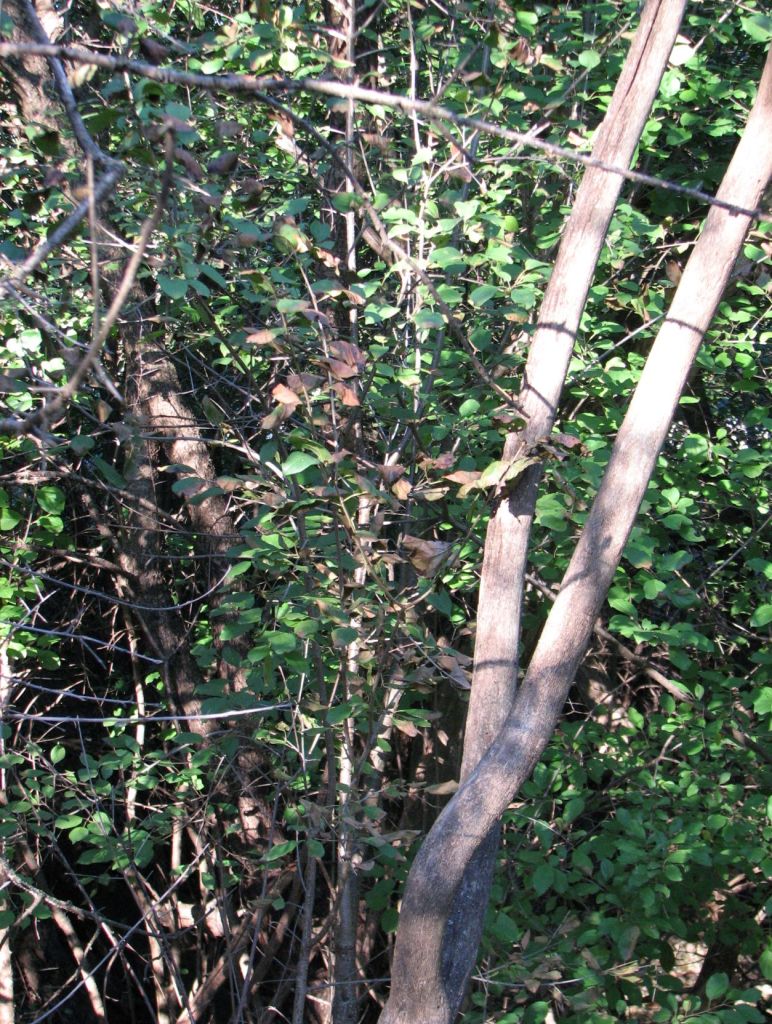
The above image shows common buckthorns that have sustained foliage impacts from herbicide transferred through root connections from a nearby buckthorn that had about 25 percent active ingredient glyphosate (+/- 2 percent) applied twice to a frill (cuts around a stem). I do not care if common buckthorns sustains off-target impacts from herbicide applications. At this level of damage, the impacted buckthorns may recover. I am posting this image to show that applying more glyphosate than the minimum found to be necessary can lead to off-target impacts.
I have also seen where gray dogwood and black raspberries showed herbicide impacts when I applied full concentrate (41 percent active ingredient) glyphosate to frills around staghorn sumac stems. I have since reduced the concentration I apply to frills on gray dogwood, sumac, and buckthorn to about 25 percent active ingredient. At this concentration, I have not observed damage to nearby untreated species. I do not care if gray dogwood or black raspberries receive off-target damage from herbicide applications. However, read the next paragraph for a plant I accidentally killed that I did not want harmed.
I applied concentrate (41 percent active ingredient) glyphosate to a frill around a common buckthorn stem that was about a foot from a prairie crabapple tree. The buckthorn was killed by this herbicide application. Unfortunately, the prairie crab apple showed herbicide damage. I was hoping the prairie crabapple would recover, but after a few years it succumbed to the herbicide damage. The reason I was controlling these buckthorns was to protect the prairie crab apple trees. This experience was one reason I decided I needed to trial more dilute herbicide concentrations to find the point where I could control the target species without killing nearby plants I was trying to protect.
I now save glyphosate concentrated (41 percent active ingredient) for applying to frills around woody species that are tough to control, like box elder and white mulberry.
 Stewardship Chronicles
Leave a comment