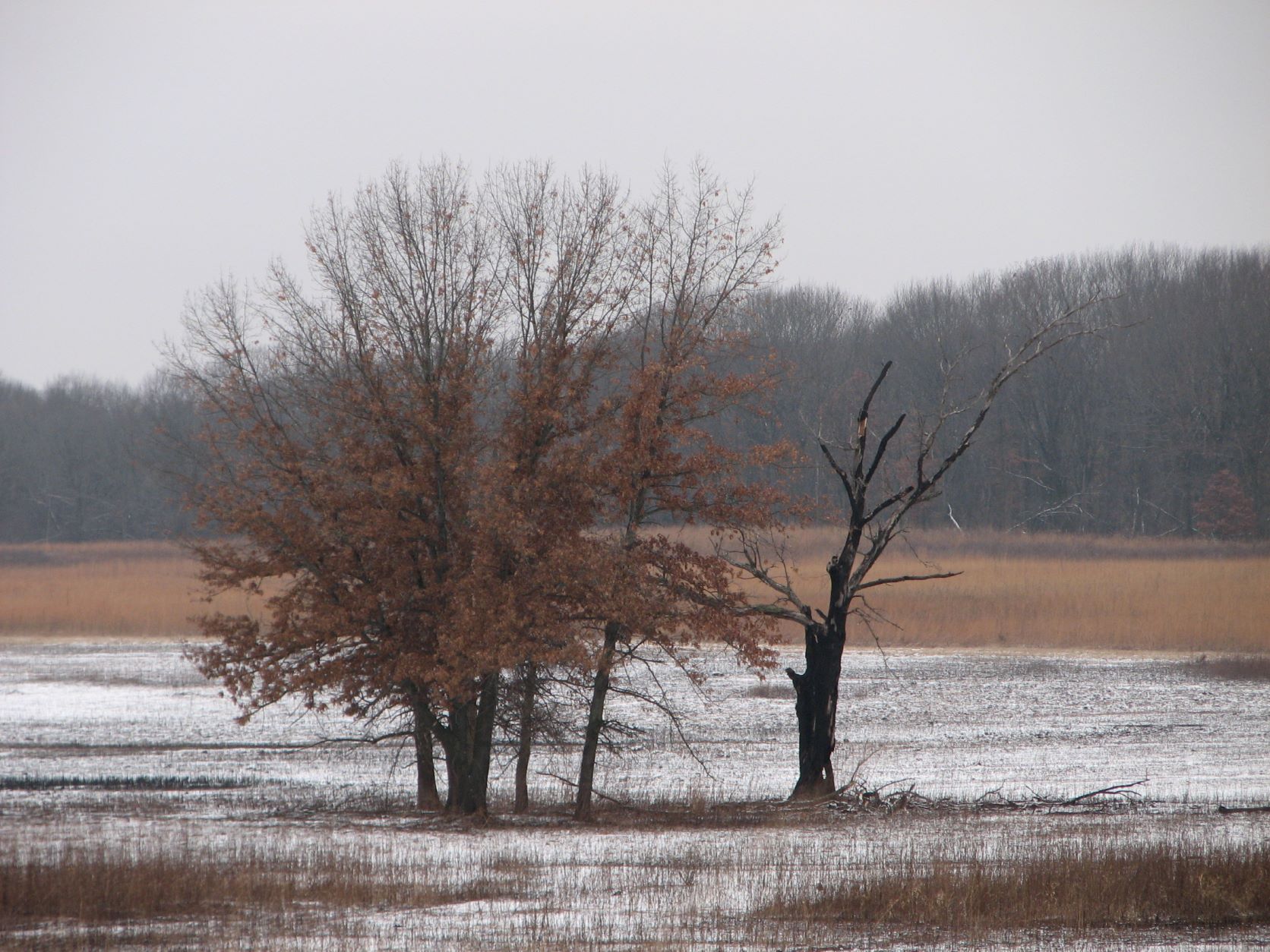
In this post, I visited the 160. The 160 is a prairie reconstruction that can be accessed by hiking east from the Beverly Lake parking lot. The Beverly Lake parking lot is known for illicit activity. Therefore, I suggest visiting in a group. A map of the area can be viewed on the previous post “Spring Creek On 1/14/2023.”
Summary
Wetland at the 160
The following wetland and wet mesic prairie plants are shown.
Riddell’s goldenrod, bottle gentian, cream gentian, stiff gentian, cardinal flower with Helen’s flower, great blue lobelia, swamp aster, a purported hybrid between New England aster and swamp aster, ladies’-tresses orchid, turtlehead, swamp lousewort, slender leaved false foxglove, grass-leaved goldenrod, dark-scaled sedge, prairie dropseed with golden Alexanders
An area where sandbar willows and small cottonwoods were mowed is shown from January 14 and from September 16th to show the contrast. An adjacent area and recently mowed area are shown and the vegetation developing is discussed.
Drier Areas at the 160
Images of the following topics are shown and discussed.
Prairie Dropseed All in a Row, Prairie Mushroom, Patches With No Tallgrass, Upland Wetland at The 160, Burn Scar
Invasive Species
Images of crown vetch, sandbar willow, teasel, and common reed control are shown with discussion.
Archaeological Dig
Two images of holes dug for archaeological purposes are shown and discussed.
Wetland at The 160
Flowers and Sedges
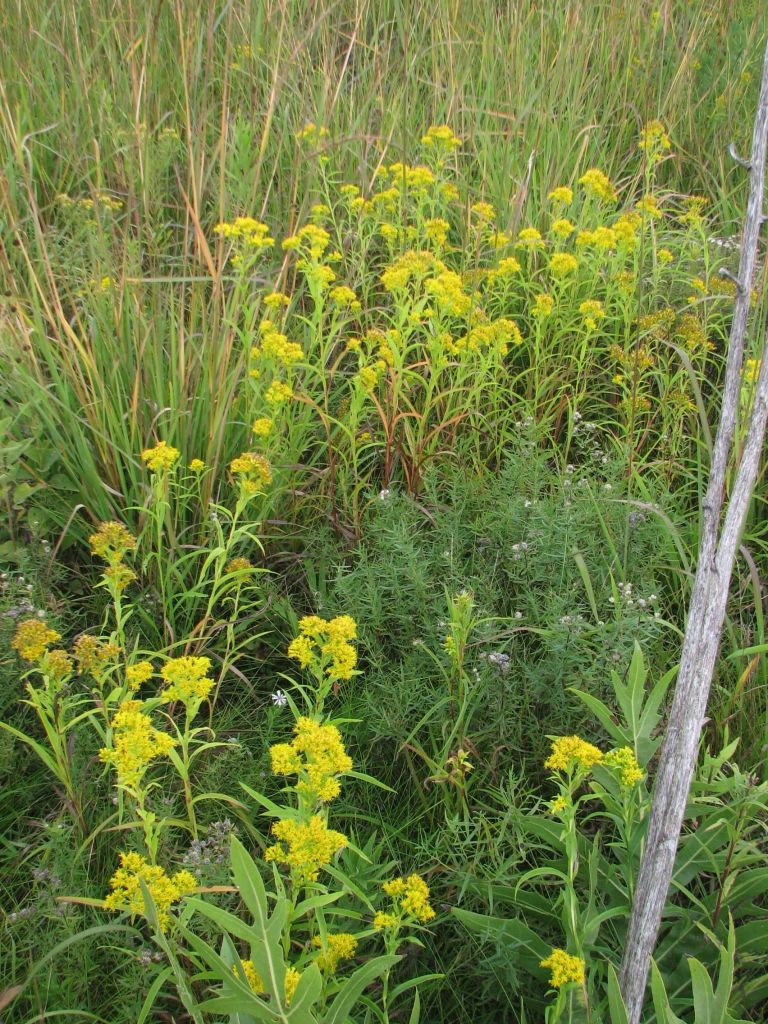
My reason for visiting on this date was to see the Riddell’s goldenrod (Solidago riddellii) in full bloom.

There is more Riddell’s goldenrod along the edge of the western part of the wetland bisecting this prairie reconstruction than I have seen anywhere else.
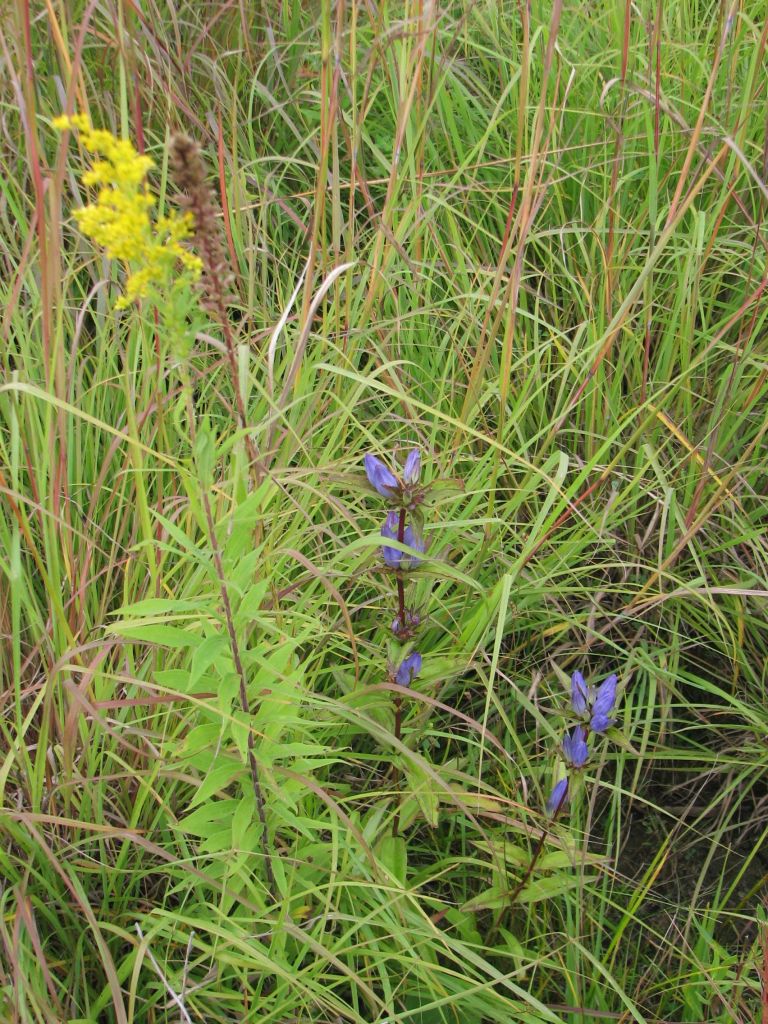
Bottle gentian (Gentiana andrewsii)

Cream gentian (Gentiana alba) with blooms just past peak.
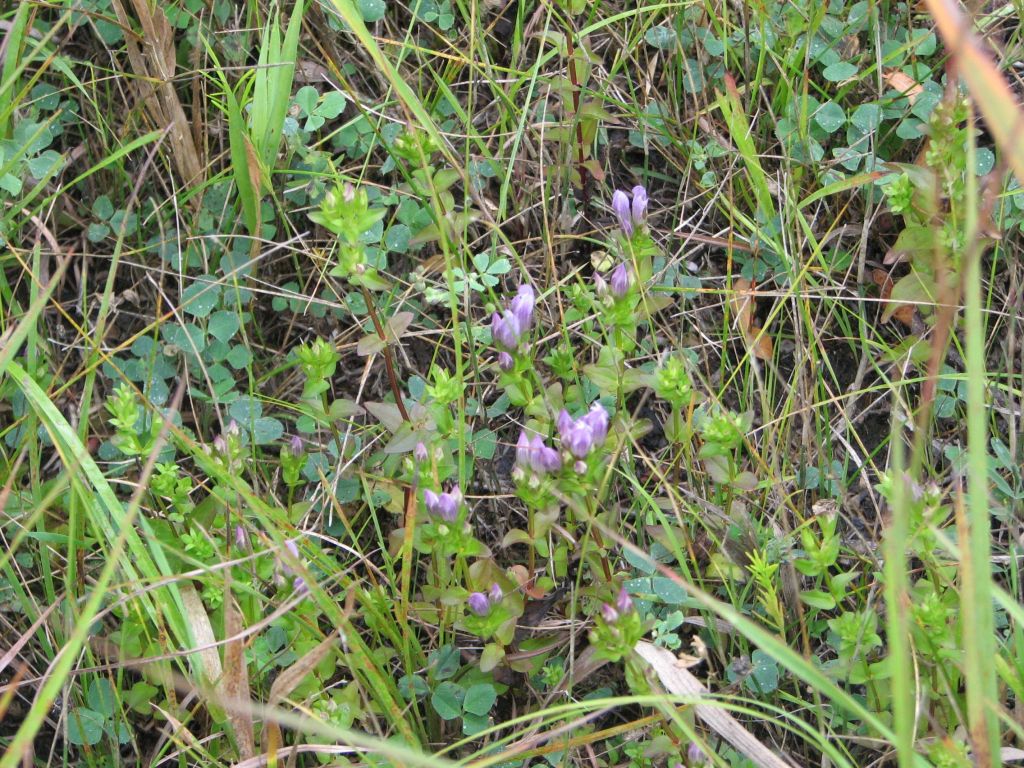
Stiff gentian (Gentianella quinquefolia)

Cardinal flower (Lobelia cardinalis) in a patch of Helen’s flower (Helenium autumnale).
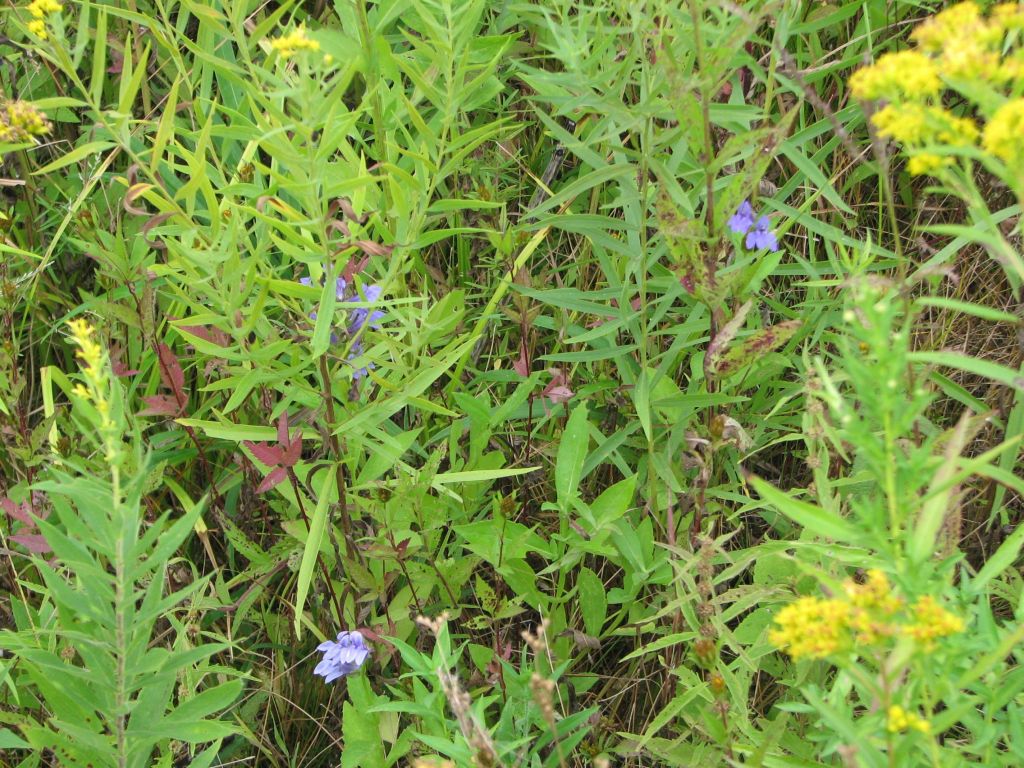
Short plants of Great Blue Lobelia (Lobelia siphilitica).
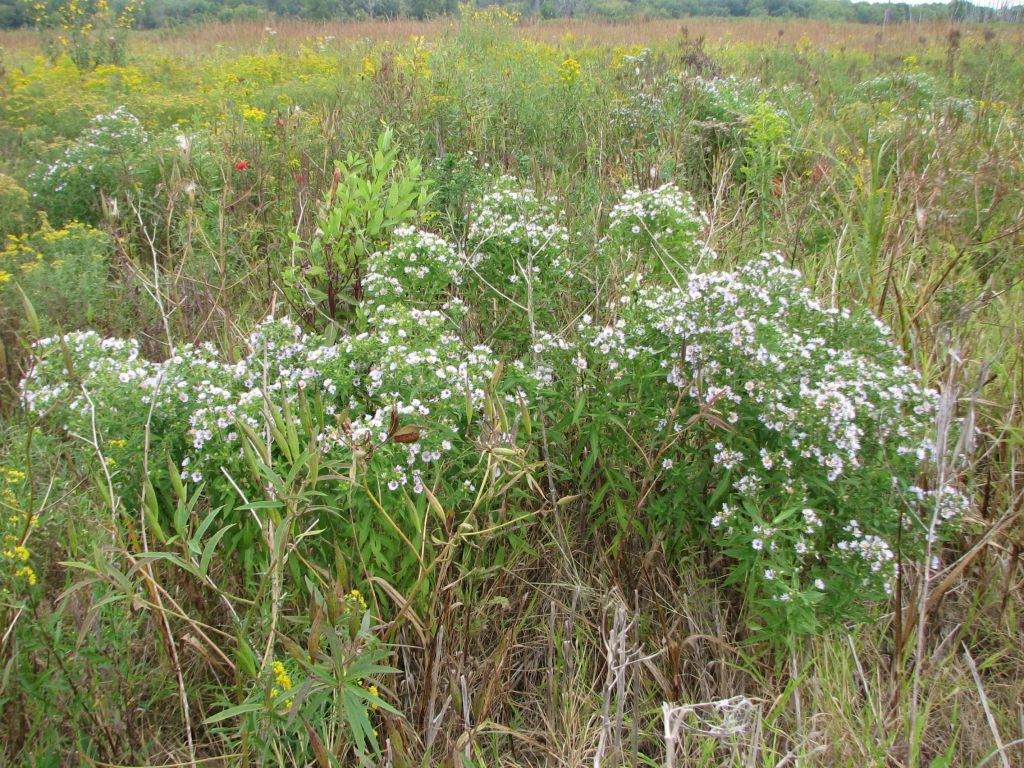
Swamp Aster (Symphyotrichum puniceum)

A plant that appears to be a hybrid between New England aster (Symphyotrichum novae-angliae) and swamp aster (Symphyotrichum puniceum).
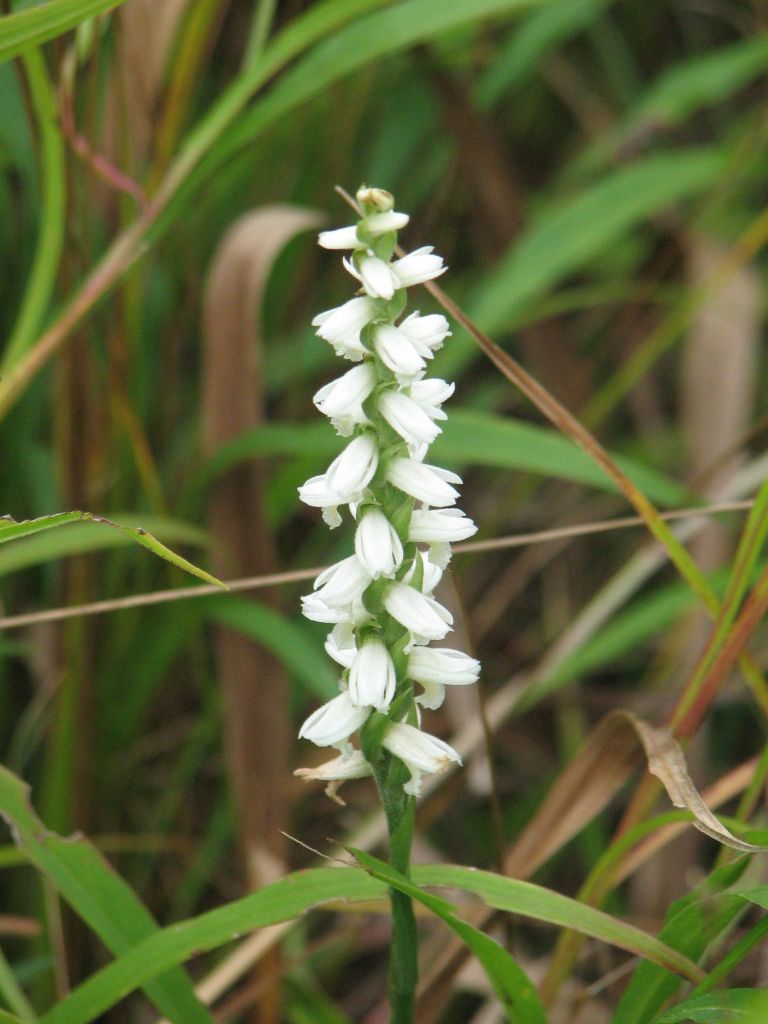
I could smell the ladies’-tresses orchids (Spiranthes incurva) before I found them.

Turtlehead (Chelone glabra)

Swamp Lousewort (Pedicularis lanceolata) that has been eaten by deer.
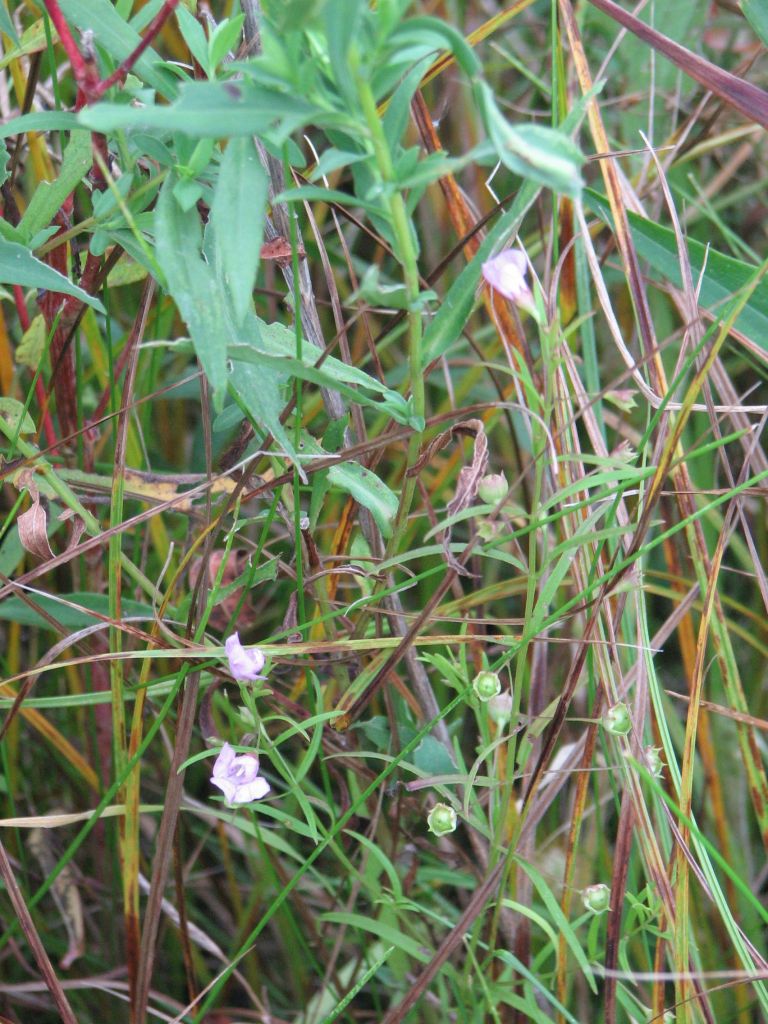
Slender-leaved false foxglove (Agalinis tenuifolia)

Grass-leaved goldenrod (Euthamia sp.) surrounded by tall goldenrod (Solidago altissima) with taller grasses in the background.

This is a patch of Carex buxbaumii (dark-scaled sedge). In April of 2013 the Spring Creek Stewards and I planted individual plugs about 20 paces apart throughout the western part of the wetland that bisects the 160. The patch of Carex buxbaumii that is visible all spread from one plug. The sedge has been matted down in the foreground. This was the case in many of the other patches too. During this dry year, the animals have used these patches of soft sedges as a place to rest.
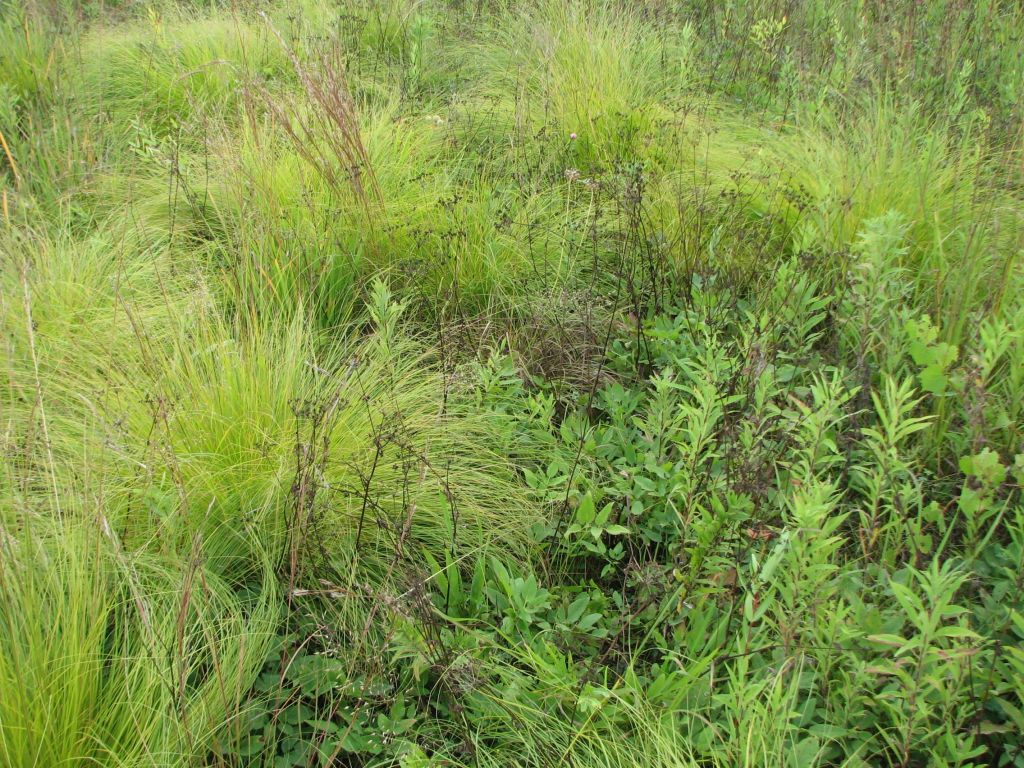
This is prairie dropseed and golden Alexanders (Zizia aurea). In wet-mesic areas there were patches composed of mostly just these two species.
Sandbar Willow and Cottonwood Mowed Area
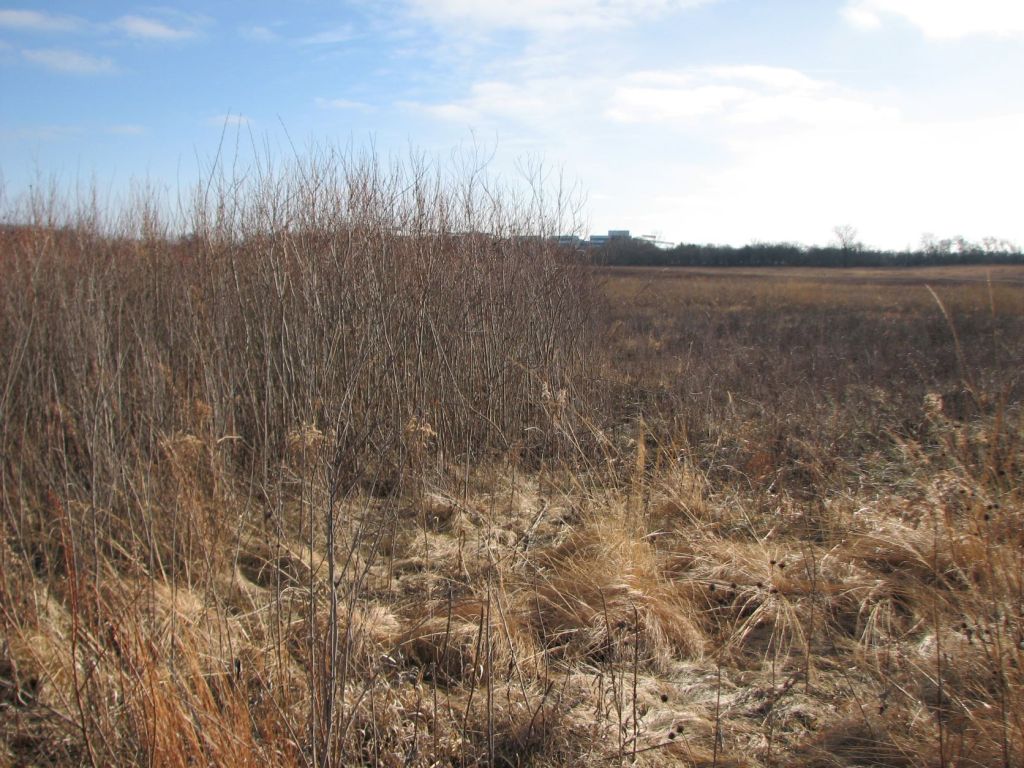
This is an image from January 14th of the edge of where sandbar willows (Salix interior) and small cottonwoods (Populus deltoides) have been mowed and treated with herbicide.

Here is an image of the same location shown above on August 16th, 2023.

View to the south of the edge of where the sandbar willows and eastern cottonwoods had been mowed and treated with herbicide. This area is full of tall goldenrod and other coarse plants. It will be a long time until this area will be better quality vegetation even with effort expended.
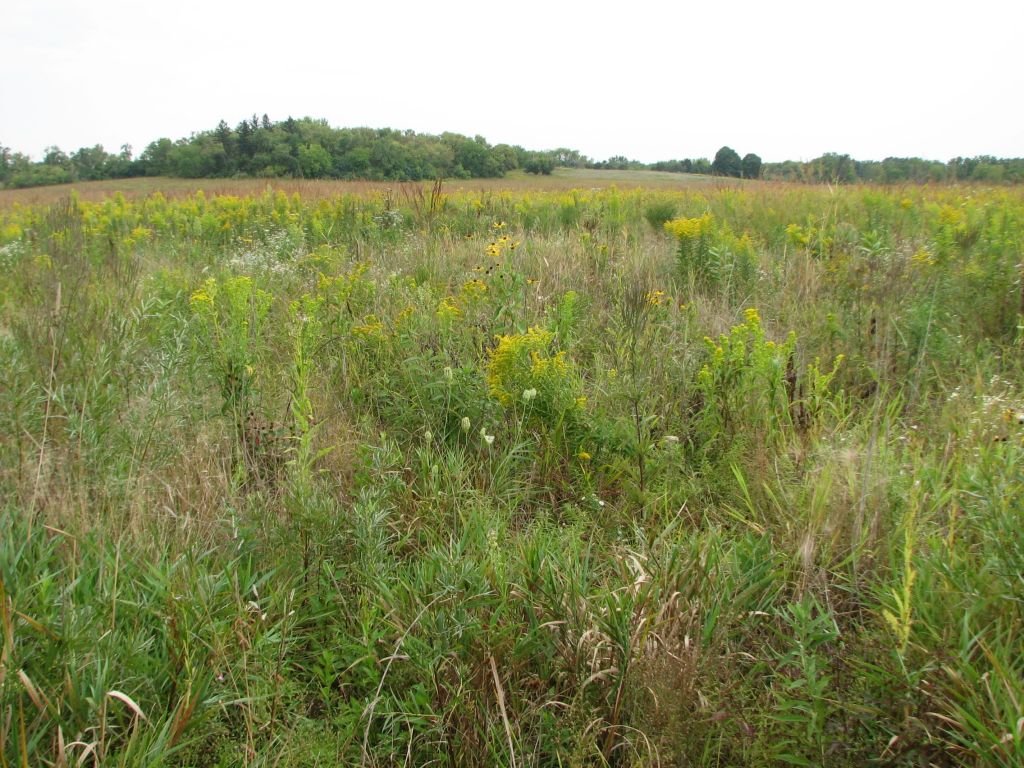
View looking directly out from the edge of the sandbar willow and eastern cottonwood stand into the recently mowed area. Reed canary grass and opportunistic weedy species have mostly filled in the area where sandbar willow and small eastern cottonwoods were mowed and treated with herbicide.
Drier Areas at the 160
Prairie Dropseed All in a Row

Prairie Dropseed (Sporobolus heterolepis) all in a row. I call this image Stephen Packard’s footsteps. Mr. Packard is frugal with his hard-earned seed and instructs people to sprinkle just a small amount as they walk to maximize the area covered.
Prairie Mushroom

Unknown prairie mushroom. I have also seen this mushroom at the main prairie reconstruction at Poplar Creek.
Added 2/25/2026 I think this is the purple-spored puffball (Calvatia cyathiformis)

Closer view of unknown prairie mushroom.
Patches With No Tallgrass

Just north of the western part of the wetland bisecting the 160 is a patch with no tall grasses. Tall grasses are visible in the background of the image. It is not competition that has kept the tall grasses from invading. Queen Anne’s lace (Daucus carota) is visible. This is biennial that does not grow where prairie vegetation is competitive. The forbs (flowers other than grasses) are diverse. These forbs all grow in areas with tall grasses. It is not the forbs that have prevented tall grasses from invading. I don’t believe anyone knows what has kept tall grasses out of these patches. Finding the cause could help solve a significant problem in prairie reconstruction – grass dominance.
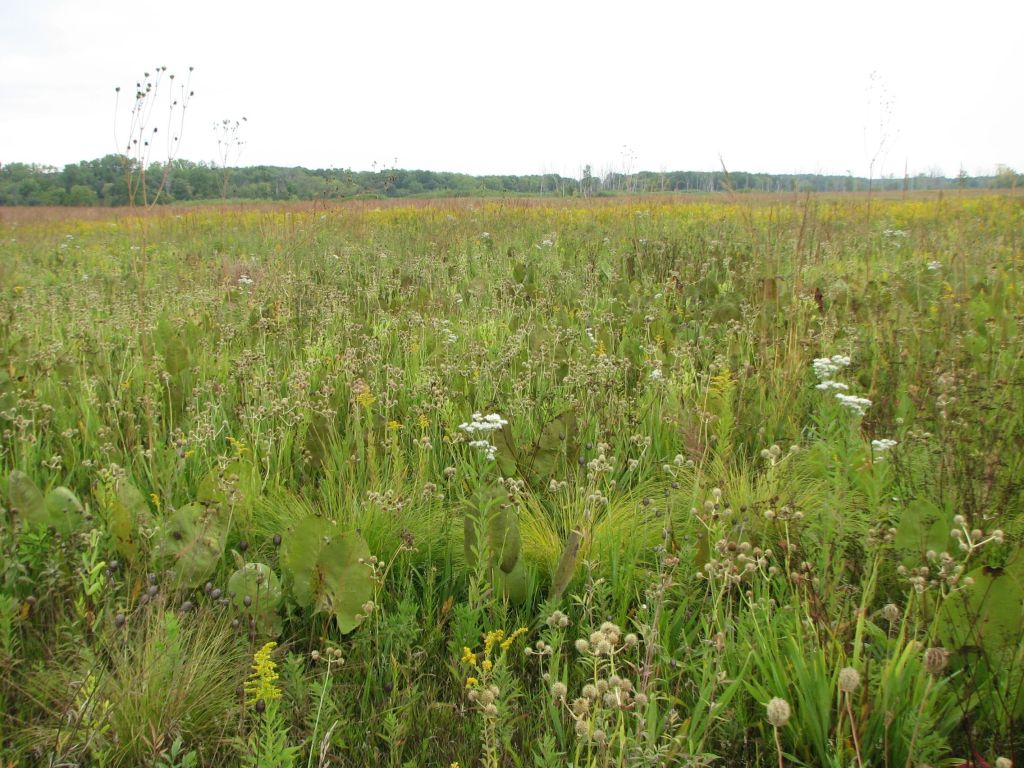
This is a different part of the same patch discussed above looking east instead of north. One Indian grass (Sorghastrum nutans) is visible in the upper right side of the image. Otherwise, there are no tall grasses.
Upland wetland at the 160
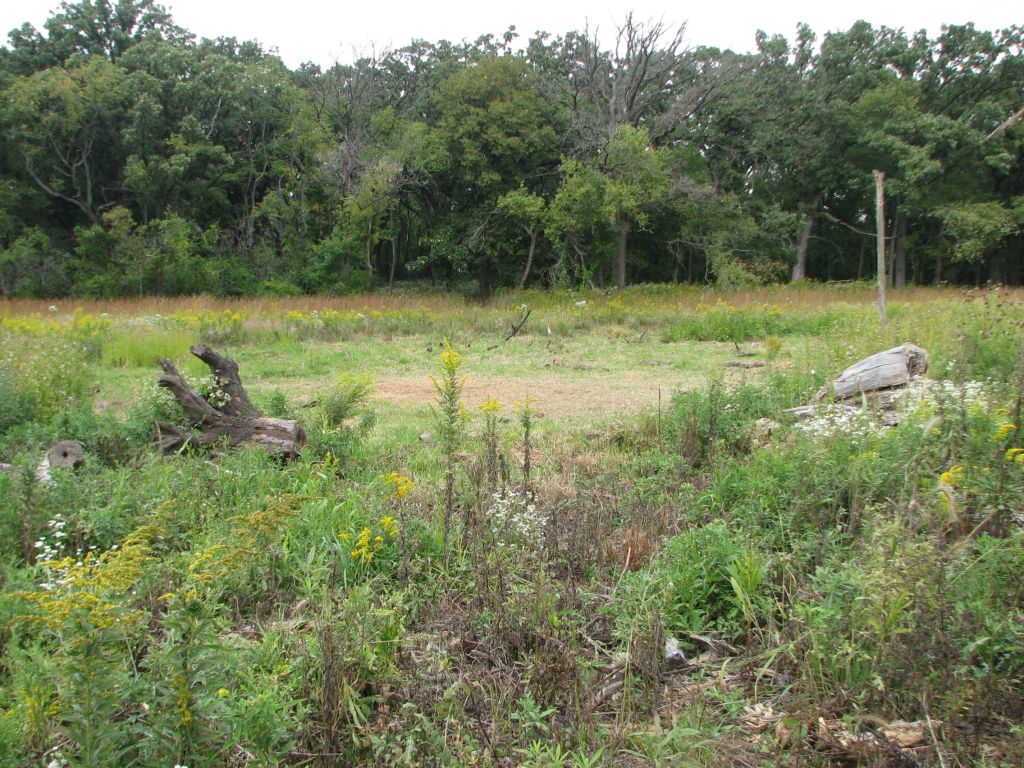
This is a wetland on the northern edge of the 160 just east of the northwestern corner. The lack of rain this year has completely dried out this wetland that is normally at least knee deep. The entire wetland now has reed canary grass (Phalaris arundinacea) growing in areas that were underwater.
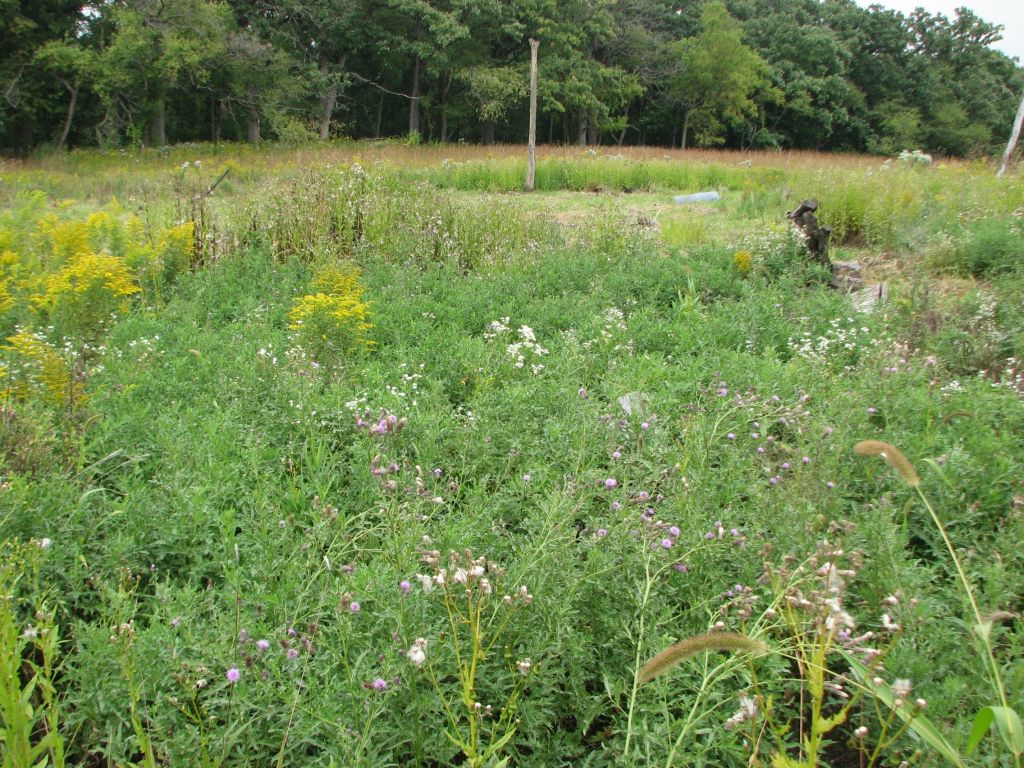
A view of the above discussed wetland from further away. Some of the areas where woody invasive species have been removed have filled with field thistle (Cirsium arvense). The field thistle patch is probably the result of spraying glyphosate to kill invasive woody species seedlings or reed canary grass. Glyphosate will kill the above ground portion of field thistle, but field thistle then sprouts from its deep roots. Since most other vegetation has been killed, spraying glyphosate typically results in a near monoculture of field thistle and/or field bindweed (Convolvulus arvensis).
Burn Scar
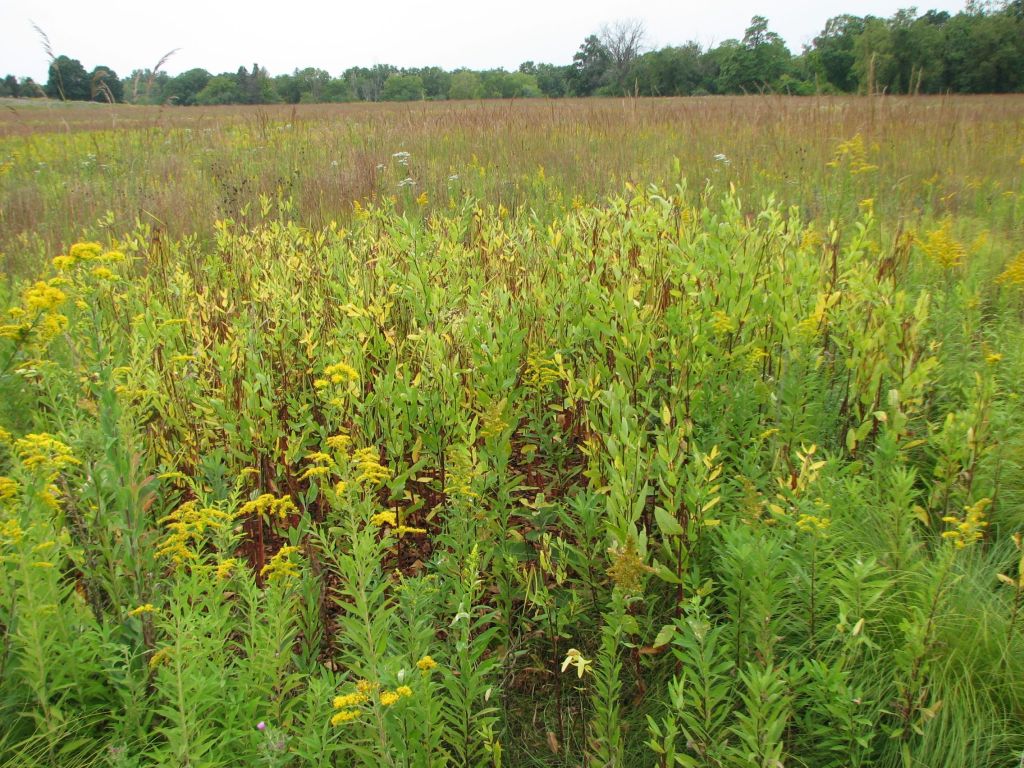
Burn scar on “The Island” in the 160. This image was taken to contrast with the image I took when I visited on 1/14/2023. Not much has changed accept the dogbane (Apocynum sibiricum) is now green.

Closer view of the burn scar showing dogbane but also other plants like common milkweed (Asclepias syriaca) and tall goldenrod (Solidago altissima). I don’t know the identity of the plant in the middle. Possibly it is a willowherb (Epilobium sp.).
Invasive Species
Crown Vetch

In the middle of this image is an invasive crown vetch (Coronilla varia) plant. I found this crown vetch plant on “The Island.” I tied fluorescent pink surveyor’s tape to a nearby rattlesnake master (Eryngium yuccafolium) so the stewards would be able to locate it and treat it. The irony is, this may have been the same crown vetch plant I found and marked years ago.

This image was taken in the unseeded old field area near the southwest corner of the 160 prairie reconstruction. This looks like an area where crown vetch was sprayed. I hope a method that causes less damage to surrounding vegetation is used when treating crown vetch in the prairie reconstruction.

Another image of where crown vetch was likely sprayed in old field vegetation southwest of the 160.
Sandbar Willow

I took this picture to show the damage from herbicide overspray. Unfortunately, the common reed (Phragmites australis) in the overspray area seems to have shrugged off the herbicide and now has a nice vegetation free zone to colonize.
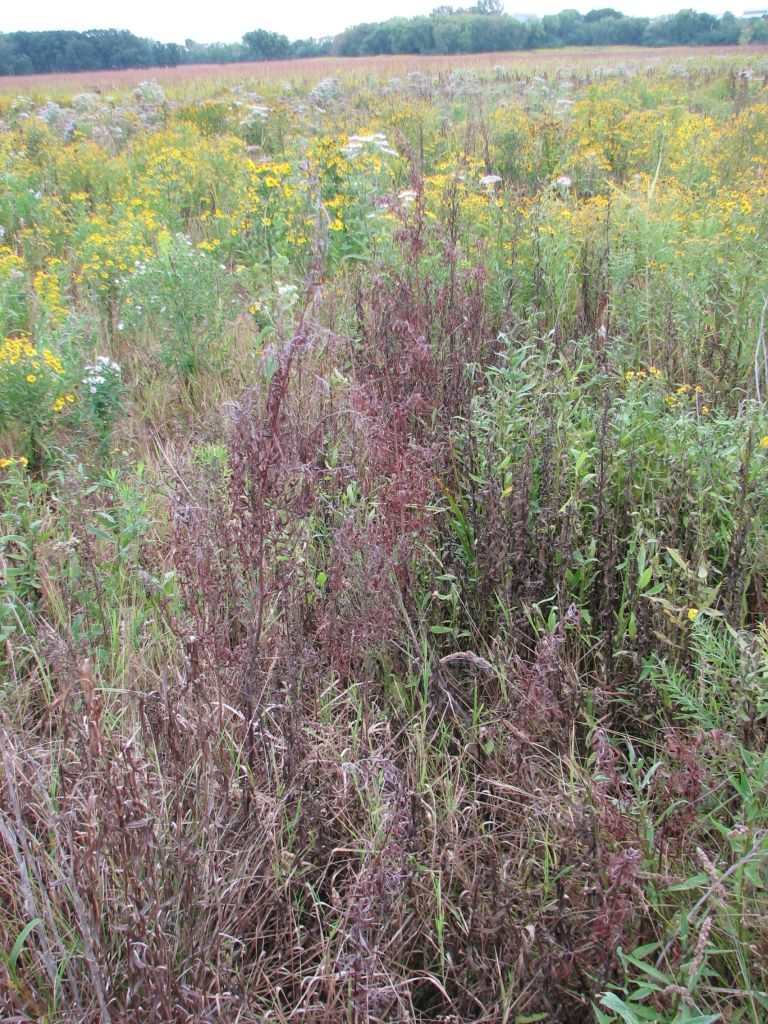
Another image of sandbar willow being treated with overspray area in the foreground.

The overspray from treating the sandbar willow killed a prairie dock (Silphium terebinthinaceum). Other treatment methods could have saved this long-lived prairie plant.
Teasel

The seed heads were cut off of this teasel (Dipsacus laciniatus). However, it was not cut off at ground level and sent up more flower spikes. It is dead now because it was treated with herbicide. If the teasel was cut off at ground level, herbicide use could have been avoided. See my September 18th post, “Where to Cut Teasel.”
Common Reed

From the amount of the lower portion that looks dead, it appears these common reeds (Phragmites australis) have been sprayed. After spraying, the common reed grew new tissue above the superficial dead looking tissue. I have seen this occur in reed canary grass I have treated that did not receive enough herbicide to kill it. Phragmites is much tougher than reed canary grass. The method of cutting the hollow stem and injecting herbicide into it should be more effective and will reduce off-target damage from overspray.
Archaeological Dig


The above are only two images of many holes that were dug in the prairie reconstruction at Spring Creek. The holes are spaced about every 20 feet. The stewards have repeatedly expressed their displeasure at having holes dug throughout an area where they have been working to restore prairie for many years.
This may have something to do with a broken spear point I found six years ago. I gave it to the Illinois State Museum as is required by law for any artifacts found on public property. At the time, I had no idea this might be the result. The likelihood of finding anything is small since this was previously farm field and the farm kids would have already picked up most artifacts.
 Stewardship Chronicles
Leave a comment