Summary
Images
Areas where two application methods were performed are shown with a description.
Applications
The effectiveness of each herbicide application method is determined.
Discussion
Preferred Method
Treatment Effectiveness
Relocating Plants Marked With Surveyors’ Tape
Improving Accuracy of Results
Further Testing
Importance of Applying Glyphosate Foam to Purple Loosestrife in Fall
Credit
Images
The below image is of purple loosestrifes (Lythrum salicaria) that had the stems cut near the ground. A roughly nickel diameter ball of twenty percent active ingredient glyphosate foam was applied to the cut surface using the Green Shoots Small Foam Herbicide Dispenser. This herbicide dispenser was used to complete all the applications described later in this post.
This bubble of foam sometimes sunk down the stem coating both the cut surface and the stem below it. This image was taken one week after this herbicide application was performed.

The purple loosestrifes marked with surveyors’ tape in the next image had 4 percent active ingredient glyphosate foam applied to the stem just above the ground coating the entire stem circumference for four inches of stem length. This image was taken two weeks after the herbicide was applied. The dark brown/almost black dead stems are Veronia.

Applications
Glyphosate Foam Applied to Stems at Base of Plants on 9/24/23
I tied surveyors’ tape on 50 purple loosestrife I planned to treat with herbicide. I applied 4 percent active ingredient glyphosate foam to four inches of stem length on 47 of the 50 purple loosestrife I was able to relocate. Applying glyphosate foam to the stem was accomplished by squirting the foam into my gloved hand and then squeezing my gloved hand around the stem to coat the entire circumference of stem with the foam. I would then pull my hand away while rubbing the palm of my gloved hand along the stem to wipe any excess herbicide off my glove and onto the stem.
After two weeks, the treated purple loosestrifes showed impacts from the herbicide application. On 10/8 I was able to relocate the three purple loosestrifes marked with surveyors’ tape that I missed treating on 9/24 and I treated these plants.
On 4/21/24, I was able to locate 33 of the 50 plants that had surveyor’s tape tied on them before having herbicide applied. The number of plants I was able to relocate was considerably less than the amount that had surveyor’s tape tied on them because deer had trampled some of the area breaking off stems and/or pushing the surveyors taping into mud. Of these 33 plants, there were 27 without any shoots growing and 6 with shoots growing. This is a control rate of 82 percent. This is good control but could be better.
Glyphosate Foam Applied to Cut Stems on 10/1/23
On this date, I applied 20 percent active ingredient glyphosate foam to cut stems of purple loosestrife in two areas.
In the first area, I marked 30 purple loosestrife stems with surveyor’s tape then returned to cut them and apply about a nickel size ball of 20 percent active ingredient glyphosate foam. I was only able to relocate 27 of the purple loosestrife stems that had surveyor’s tape tied on them for treatment. On 4/21/24, I was able to relocate 13 of these marked and treated purple loosestrife stems. None of these stems were sprouting.
In the second area, I tied surveyors’ tape on 20 purple loosestrife stems. I then cut and applied herbicide to all these stems using the method described above. On 4/21/24, of the 19 stems with surveyors’ tape I could relocate, I counted one that had sprouted from the ground and 18 that had no sprouting.
The results from both areas together treated on this day yields a treatment effectiveness of 97 percent. I consider this result to be excellent.
Glyphosate Foam Applied to Stem at Base of Plants on 10/8/24
I tied surveyors’ tape to 50 purple loosestrife stems. I was then able to relocate at least 49 of these 50 stems to apply 4 percent active ingredient glyphosate foam to a four-inch length of stem just up from ground level. On 4/21/24, I was able to relocate 44 of the stems marked with surveyor’s tape. Only one of these stems had sprouts emerging from the ground near a stem marked with surveyor’s tape. This yields a treatment effectiveness rate of 98 percent. I consider this to be excellent.
Discussion
Preferred Method
The method I will use going forward is cutting the stem and applying a ball of glyphosate foam to the top of the cut stem. This method is easier and faster than applying the herbicide foam to four inches of stem length at the base of the plant while wearing shoulder length gloves. The shoulder length gloves are hot and uncomfortable. Squirting glyphosate foam from the Small Foam Herbicide Dispenser directly onto the cut stems has the additional benefit of not needing to get herbicide directly on gloves while doing the application. This reduces the possible exposure to herbicide from permeation through gloves.
It is easy to hold pruners in one hand and a Green Shoots Small Foaming Herbicide Dispenser in the other gloved hand to quickly accomplish cutting the stems and applying herbicide. The less skin I must cover with a chemical resistant barrier (gloves, boots, aprons, etc.) the more comfortable it is to perform an application.
Treatment Effectiveness
There is a significant difference between the treatment effectiveness for the treatments done on 9/24/23 and 10/8/2023. Since these treatments were done in the same manner, I think the difference was the dates. As the herbicide treatment occurred later in fall it may have been more effective because plants were transporting food to the roots.
Added Later: It is rather unlikely a difference of two weeks would be enough to cause the difference in treatment effectiveness I observed. The variation in treatment effectiveness is likely because I was applying a concentration and amount of herbicide that was just at the point that resulted in good to excellent control. The variability in treatment effectiveness is likely resulting from the variability in vigor of invasive species growing in different areas.
Added 7/10/2024 – I looked at historical weather data. Rain occurred the morning after the application on 9/24/2023. After the application on 10/8/2023 rain did not occur for three days. It is likely rain occurring so soon after the herbicide application is the reason for the reduced effectiveness on 9/24/2023.
Relocating Plants Marked With Surveyors’ Tape
I often was not able to relocate all the plants I had marked with surveyor’s tape for treatment. This is important for getting accurate treatment effectiveness rates. In the future, I will temporarily put utility flags by the stems I marked with surveyor’s tape so I can find all the marked stems and treat them all. This will assure that the stems I find with surveyor’s tape tied to them the next growing season have all been treated.
Improving Accuracy of Results
Purple loosestrife sprouting from the ground near marked plants could have been because the herbicide treatment did not kill a plant, the plant missed being treated, or because there was a purple loosestrife adjacent to the treated plant that did not get treated. I try to treat all purple loosestrife in an area, but I invariably miss some. There is a possibility that the sprouting stems next to a treated stem are a purple loosestrife that was not treated. In the future, to be sure sprouts coming out of the ground are from plants that had been treated, I need to both flag the stems with surveyors’ tape tied to them until treatment of a plant is complete and when evaluating results dig into the soil to make sure the sprouts originate from the same roots as the treated purple loosestrife stems.
Further Testing
The one plant that sprouted after having the cut stem treated with 20 percent active ingredient glyphosate foam was surprising to me. This is a high concentration applied in a way that should maximize getting herbicide into the plant. I thought this concentration would be more than necessary. I will have to trial applying various amounts of herbicide at various concentrations this fall to determine if I can reduce the herbicide I am applying.
Importance of Applying Glyphosate Foam to Purple Loosestrife in Fall
I did this application of glyphosate foam to purple loosestrife back in the spring of 2022. I increased the amount of 4 percent active ingredient glyphosate applied from four inches of stem length at the base of the plant to full coverage (shown in below image). In spring, only completely covering the plant proved to be effective at this concentration. However, off-target damage at this level of coverage was severe.
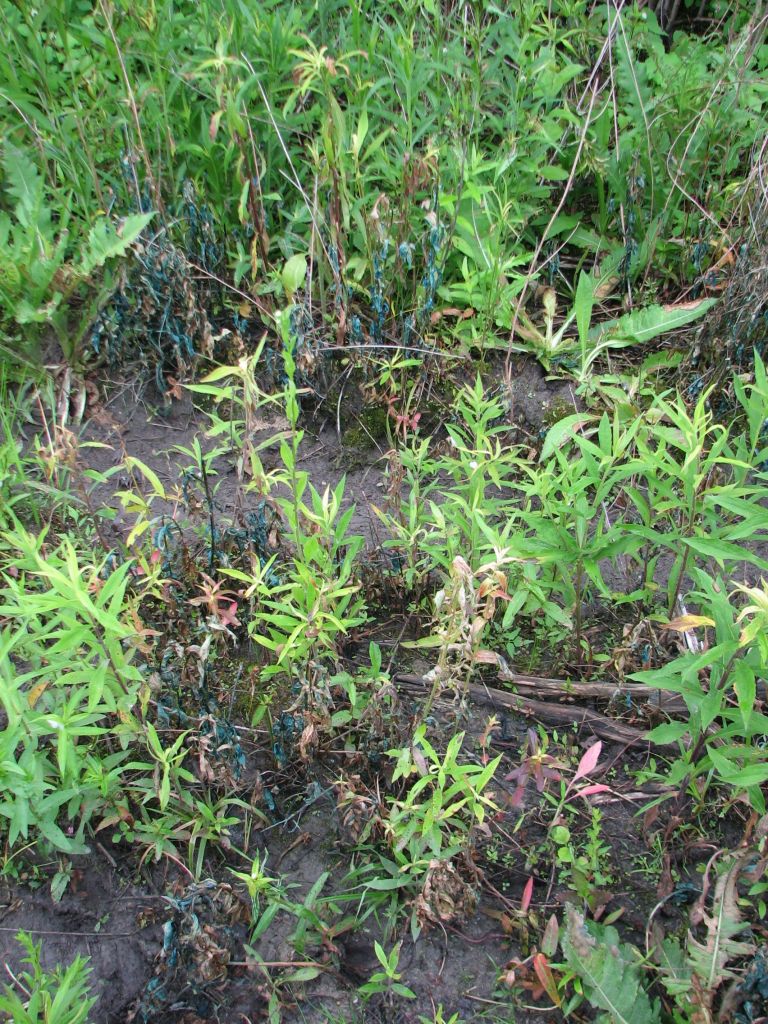
I used a gloved hand to apply the herbicide trying to be careful not to get it on adjacent plants. Impacts are from rain splashing herbicide off the purple loosestrife onto non-target vegetation.
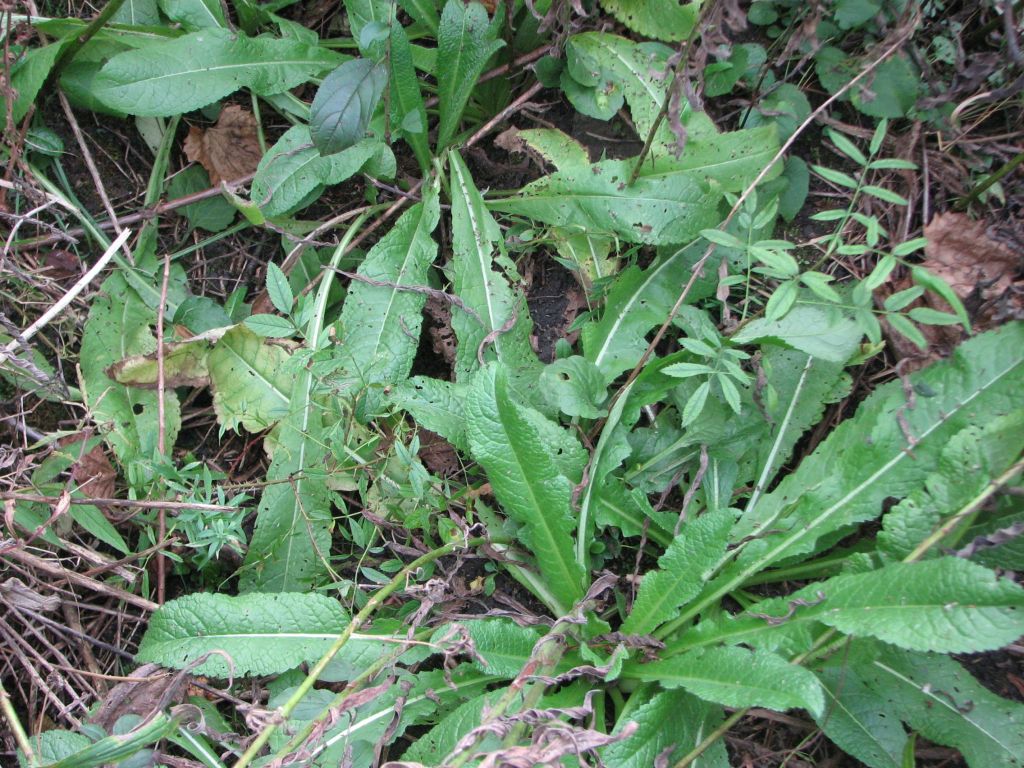
The below image was taken in the fall of 2023. Over a year after the herbicide application, wild rose is still showing impacts from herbicide I had carefully applied in the spring of 2022 to purple loosestrife.
A significantly reduced amount of herbicide is needed to achieve good to excellent treatment effectiveness in fall. Both applying to four inches of stem length at the base of plants, or to cut stems, during fall requires less herbicide and reduces off-target impacts. With fall applications, off-target impacts are reduced to the point I did not see them. I have been working to improve effectiveness and reduce off-target damage of herbicide applications for years and have improved tremendously over time.
Credit
The idea of applying the herbicide foam to cut stems of purple loosestrife originated when I attended a workday hosted by Kathleen Garness at Hosah Park. Ms. Garness applies 15 percent active ingredient glyphosate to cut stems of purple loosestrife using gooseneck bottles. I hope to compare Ms. Garness’ technique to applying various concentrations of glyphosate foam to cut stems of purple loosestrife in the future.
 Stewardship Chronicles
Leave a comment