The images below are a sequence from an area where common buckthorns had been controlled. The common buckthorns dominated this area. This area was along the edge of extant prairie vegetation. The area where common buckthorns had been controlled was high-quality prairie vegetation before it had succumbed to the expanding front of common buckthorns.
The common buckthorns in the image below were killed by applying triclopyr ester in basal oil to the basal bark during the winter of 2018/2019.
When this application was done, I had not yet determined how much stem must be covered to kill common buckthorns of various sizes. I followed the manufacturer’s recommendation, which I have since found to be more than is needed for smaller stem diameter invasive woody species. A bigger mistake was precipitation started to occur as I stopped applying herbicide. As I’ve discussed on numerous posts like “Ring of Death,” “Ring of Death – 2023/2024 Dormant Season Application”, and “Getting Basal Bark Application Right” there will be damage if the triclopyr ester in basal oil is applied too soon before rain/wet snow occurs. The precipitation soon after the application caused this area to be heavily damaged by herbicide being washed into the soil.
The year after the common buckthorns were treated, the herbicide damaged areas shown in this post were mostly foxtail grass (Setaria species).
Image Taken on May 2nd, 2021.

This was two growing seasons after the treatment of the common buckthorns had begun. You can see the common buckthorns have been colonized by fungi and have mostly fallen over. Some were helped with the falling over part, by my foot, as I went through the area doing follow up treatments.
Images taken on October 17th, 2021.

At the end of the third growing season after the common buckthorn where treated, the ecosystem reminds me of what Obi-Wan-Kenobi says about the Mos Eisley Spaceport in the movie Star Wars: Episode Four – A New Hope, “You will never find a more wretched hive of scum and villainy.”
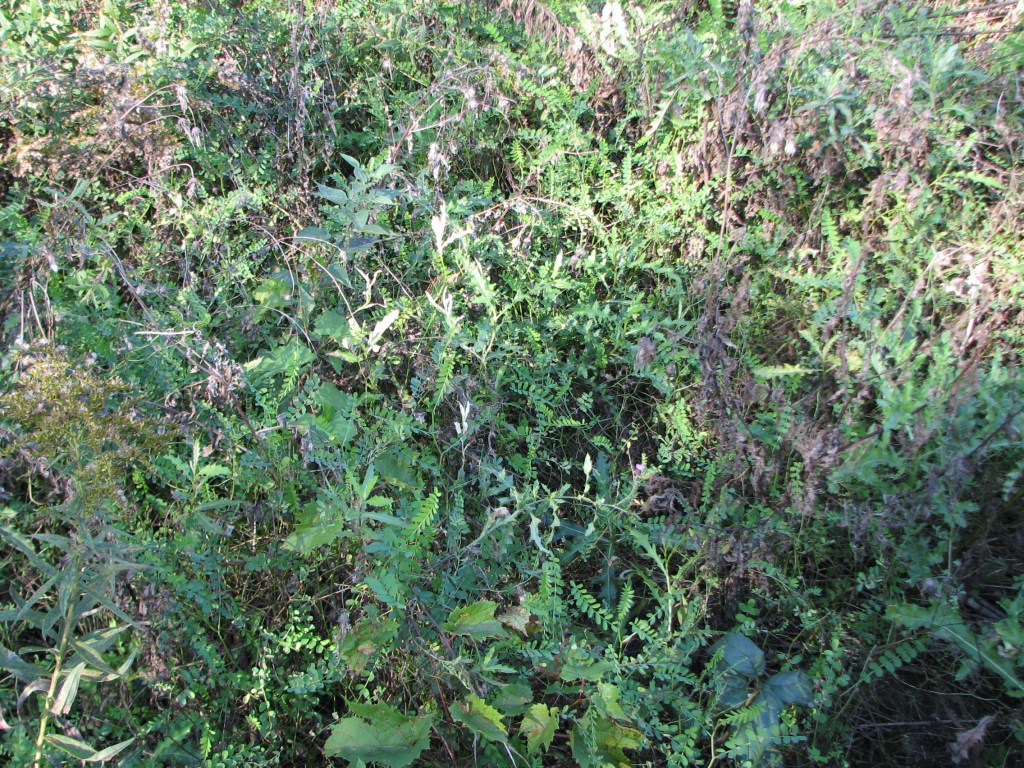
The above is a closer view of the mess of invasive species that is growing during the third season after common buckthorn had been controlled further along the edge. I have since been able to reduce the amount of field thistle after treating common buckthorn. I do this by carefully applying triclopyr ester in basal oil in a manner that does not get any on the soil and applying this herbicide at least four days before rain occurs. When applying glyphosate to frills around stems, I typically get burnweed (Erechtites hieraciifolius) instead of the above shown weeds. Whether the above is what develops, or burnweed, the vegetation after buckthorn has been removed is a response to soil changes (caused by buckthorn) that need time to reverse before higher-quality vegetation will establish.
Images taken on July 7th, 2022.

The “wretched hive of scum and villainy” has mostly subsided. The problem that persists is crown vetch.

This is a closer view along the same edge.
Image taken on 8/3/2025.

I had previously applied glyphosate foam to crown vetch using the methods discussed in the following blog posts.
“Hosah Workday 6/14/2025,” “Crown Vetch Control Using Green Shoots Foaming Herbicide Dispenser to Apply Directly to Foliage,” and “Selectivity of Glyphosate Foam”
Flowering spurge (Euphorbia corollata), mountain mint (Pycnanthenum virginianum), and prairie sunflower (Helianthus pauciflorus) have increased in the area formerly dominated by common buckthorn. I thinly spread seeds into the bare spots where crown vetch had been controlled. However, I do not think this made much difference in this case. I did not spread seed of flowering spurge into the area shown. The prairie sunflower spread vegetatively into the area shown.
The prairie grasses in the foreground were along the edge that received enough light that they were still surviving when control of common buckthorn had begun. Native graminoids have not yet developed in areas that had been completely dominated by common buckthorns. This is not necessarily bad, since native graminoids often dominate restoration areas.

The above is a closer view showing some of the wood that has not yet decayed. A forestry mower was run through this area early last winter. This broke up the wood that remained into smaller pieces. Both crown vetch and small common buckthorns that need follow-up treatment are visible.

This is in the same treatment area further along the edge.

A closer view showing woody debris. As before, crown vetch is visible and needs continuing treatment.
The wider-view images taken on 8/23/2025 all show staghorn sumac (Rhus typhina) in the background. This woody invader of prairies has taken over a few of the areas where I had controlled common buckthorns, but not the staghorn sumac. Staghorn sumac is also spreading into prairie areas by seed or vegetatively from existing clones. I will need to control the staghorn sumac to prevent more prairie from being lost and allow prairie vegetation to expand into areas where it had been present before.
 Stewardship Chronicles
Leave a comment