Summary
View of Work Area
View of Canopy
Time After Treatment Until Control Occurs
Basal Sprouting
Discussion
Effectiveness, Efficiency, Trade-offs, Future Goals
Decomposing Common Buckthorn
View of Work Area
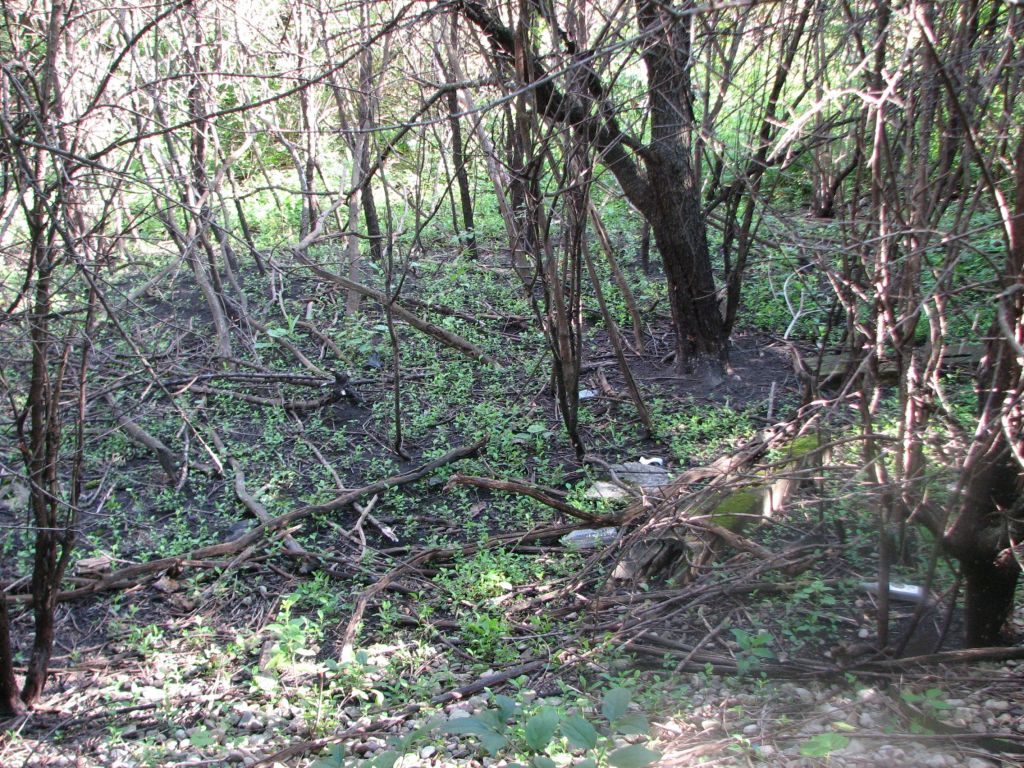
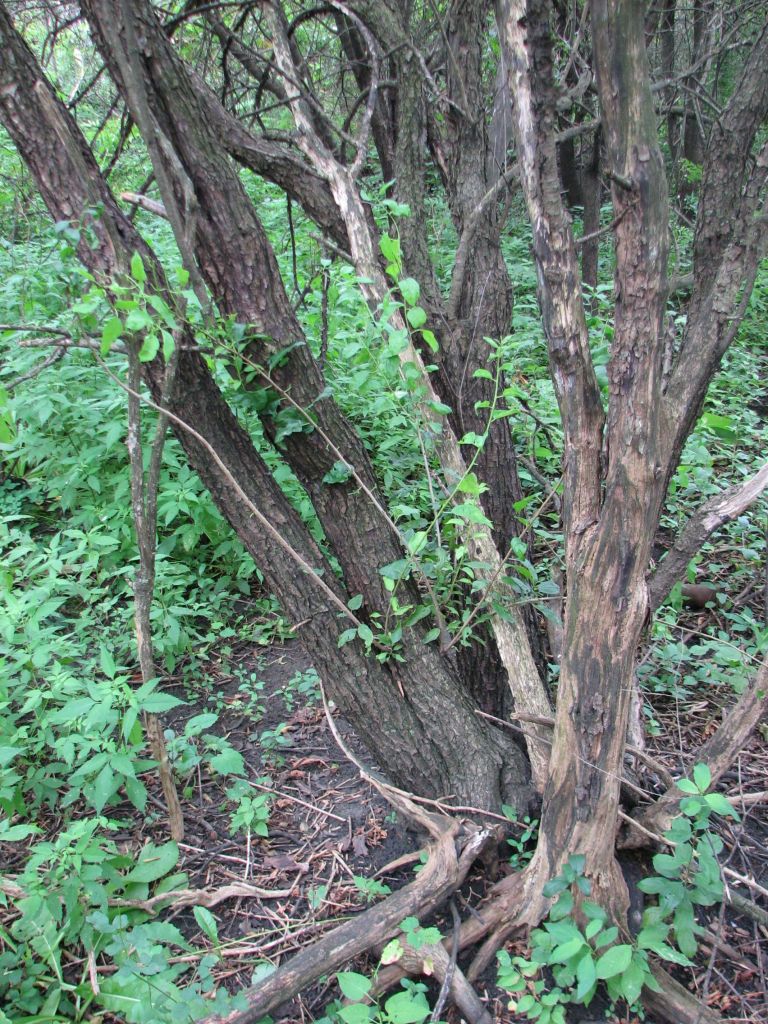
The below image is the ground under common buckthorns (Rhamnus cathartica) that had been controlled with 20 percent (V/V) triclopyr ester in basal oil applied to the basal bark. Rain occurred three days after the herbicide application. Typically, I want four, or preferably more, rain free days after applying this herbicide to avoid off-target damage. A lot of the bare ground that is visible is root exclusion of common buckthorn seedlings by the large dead common buckthorns. Some of the common buckthorn seedlings visible in the image are stunted and yellow. The ring-of-death is more than I typically prefer, but this does not matter much considering all native vegetation has been shaded to death by common buckthorns. All that is growing in the ground layer are common buckthorn seedlings and bittersweet nightshade.
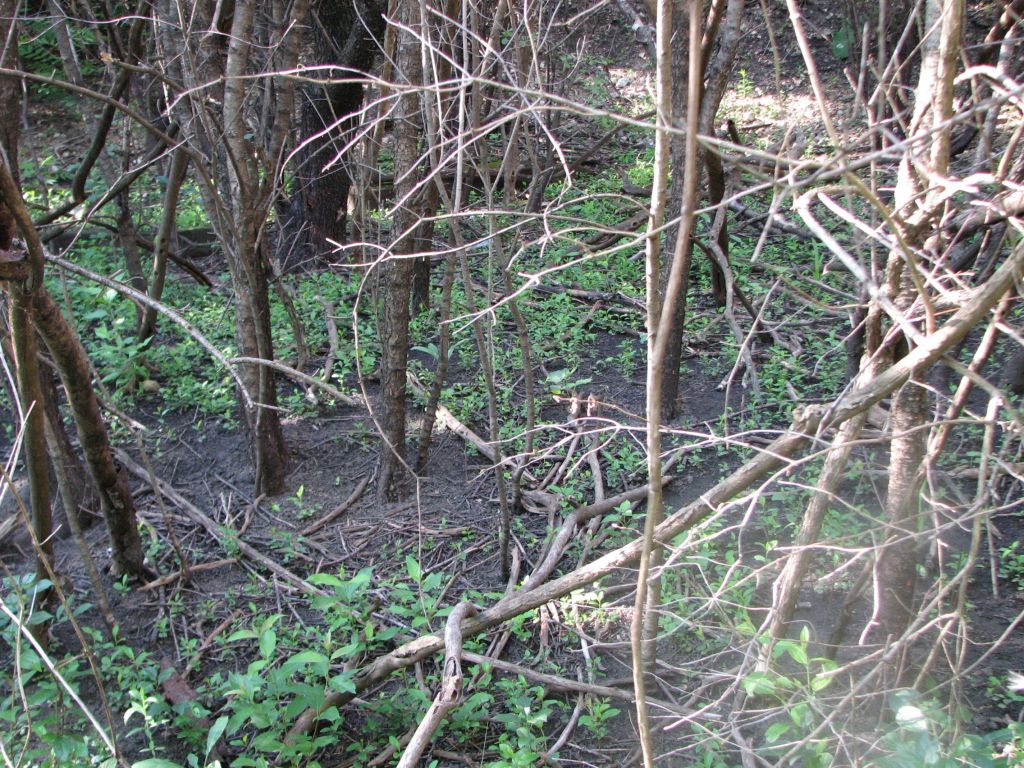
View from the opposite side.
View of Canopy
This is the view toward the sky from the edge of the above shown controlled common buckthorn thicket on July 21st, 2024. The common buckthorns have all been killed in this treatment area.
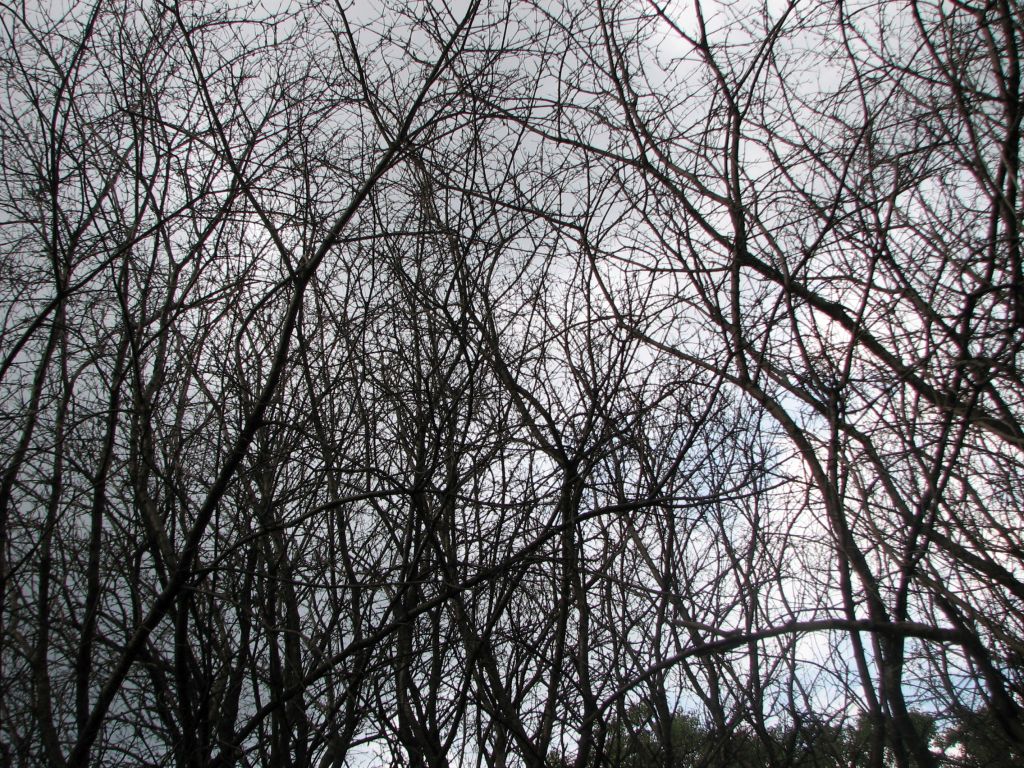
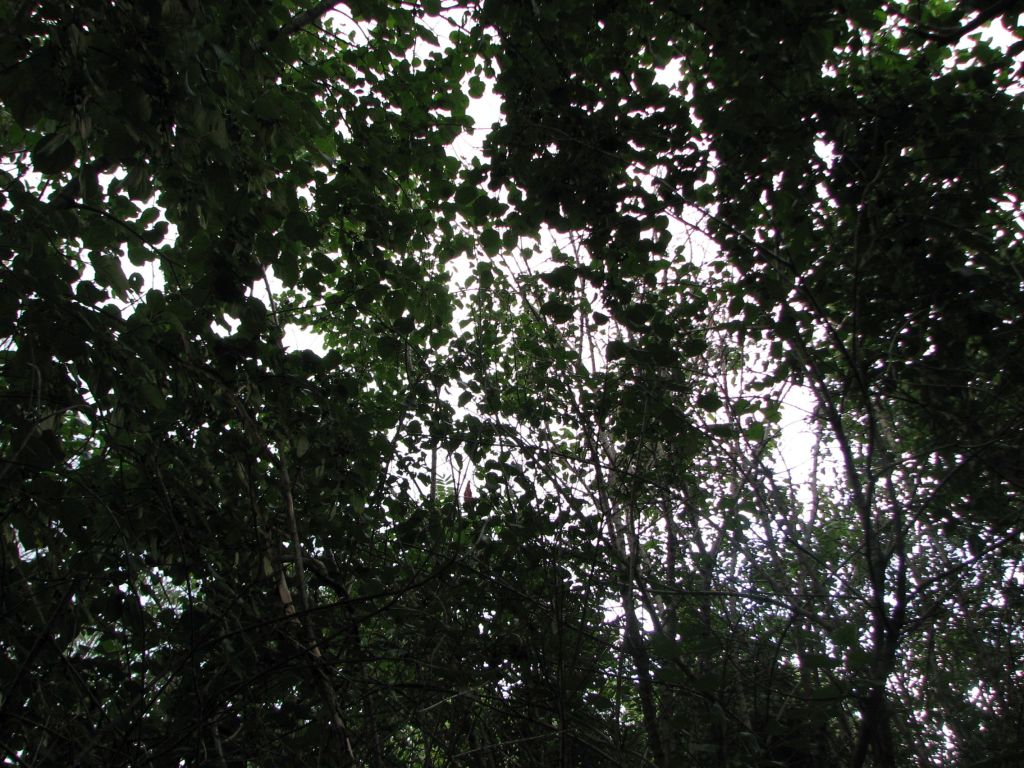
Below is the view toward the sky of an area I had treated during the winter of 2022/2023. I had covered 20 percent less stem length relative to the diameter at ground level during the herbicide application in the image shown below compared to the images shown above. In the image shown below, about half of the common buckthorn were killed. It is surprising to me that a relatively small increase in the amount of herbicide could go from the very poor control, shown below, to complete control, shown above.
Time After Treatment Until Control Occurs
I was told that it can take 18 months for treated woody species to die from an herbicide treatment. Consequently, I did not apply herbicide a second time to the common buckthorns that survived the herbicide treatment done in 2022/2023. I waited to see if more treated common buckthorn would die by the second growing season after the treatment. However, no further common buckthorns died by the end of this, the second, growing season.
My experience has been, if treated woody species are not dead by the following fall then they will not die and should be treated again the following dormant season. The growing season after treatment, woody invasive species often grow leaves. If the woody invasive species are going to die from the herbicide application, then this typically occurs before July.
Sprouting
The Illinois Nature Preserve Commission’s Vegetation Management Guideline for exotic buckthorn states ”Basal Bark Application was found to allow significantly more resprouting than application to a cut or girdled stem.”
This has not been my experience. What I have previously seen is the common buckthorns I have treated with a basal bark application either die or they do not, but none of them grew basal sprouts. As I increased the stem length covered with herbicide proportional to stem diameter at ground level, a few of the common buckthorns had enough of the canopy killed that a sprouting response occurred. Sprouting seems to only occur rarely when slightly less herbicide than necessary to completely kill the woody species had been applied.

Discussion
Effectiveness
I have had applications that have only been partially successful for many years. This resulted in me treating many common buckthorns again. It is gratifying to have finally increased the amount of herbicide I applied incrementally to the point that complete control of common buckthorn was achieved.
Efficiency
Many times the number of common buckthorns can be controlled if herbicide is applied to the basal bark compared to cut stump applications. Previously, I estimated eight times the number of medium size common buckthorns could be controlled with basal bark application versus cutting with a bow saw, hauling, and burning.
Tradeoffs
There are two trade-offs of using basal bark application. The first is basal bark applications requires much more herbicide for larger common buckthorn than cut stump application. The second is with basal bark application, the stem is left standing.
The savings in labor are more than justified by the increased herbicide cost. Damage to non-target plants can be avoided if triclopyr ester in basal oil is applied during the dormant season and is applied enough days before rain occurs.
I am still investigating if leaving the dead stems standing is positive, negative, or neutral. It is my belief that leaving the dead wood standing is better than burning the wood in a bonfire since it avoids burn scars. Leaving the wood standing is faster and easier than cutting, hauling, and burning/chipping. One positive benefit of leaving wood standing is woodpeckers forage for insects in the decaying wood.
Future Goals
I will not be attempting to restore the core of the dead buckthorn thicket into prairie. I do not think such an attempt would be successful for a considerable amount of time. My goal is to first control the common buckthorns, then the common buckthorn seedlings, and finally any crown vetch (Securigera varia) that develops later while letting native weedy species dominate as the larger common buckthorns decompose. I will put my prairie restoration efforts into the edge of where the common buckthorn thicket has been controlled. Soil on the edges of the thickets has been less damaged by the common buckthorn invasion and restoration is more likely to be successful.
Where thickets of common buckthorns have been killed, the vegetation at first becomes weedy. Along the edges of the former buckthorn thicket, prairie species may establish if crown vetch is controlled. Further into a common buckthorn thicket, after several years the vegetation tends to develop into mostly tall goldenrod. Where common buckthorn has rotted and fallen over, tall goldenrod does not grow. In the area where rotting common buckthorns have fallen over and are decomposing there tends to be crown vetch in drier areas and purple loosestrife in wetter areas. In wetter areas, the purple loosestrife would be present regardless of the rotting common buckthorn wood. However, where there is rotting common buckthorn in drier areas, crown vetch appears to be present because tall goldenrod is excluded. Tall goldenrod does not grow where the fallen common buckthorn wood is rotting. I think this is because soil nitrogen has been reduced by the rotting wood.
Added 10/19/2024 – The tall goldenrod may not have grown where common buckthorns controlled with basal bark herbicide had fallen over because of shade cast by the common buckthorns when they were alive. I will have to wait several more years to see if tall goldenrod eventually colonizes these spots.
The next iteration in this process is to control the crown vetch and purple loosestrife and see what establishes where the common buckthorn wood is rotting. I will sow some seeds of native plants trying to get something to establish in areas where crown vetch has been controlled. In areas where tall goldenrod is dominating, I plan to control any buckthorn seedlings and hope that the soil adjusts over time to favor higher quality native plants. This is something I don’t believe I can speed up by controlling tall goldenrod. My experience has been tall goldenrod will return and dominate again if the soil has not recovered.
If I have success establishing prairie species where common buckthorn wood is rotting then I will focus restoration on these areas. I may even spread wood in tall goldenrod patches to reduce the tall goldenrod and help get prairie species established.
Decomposing Common Buckthorn
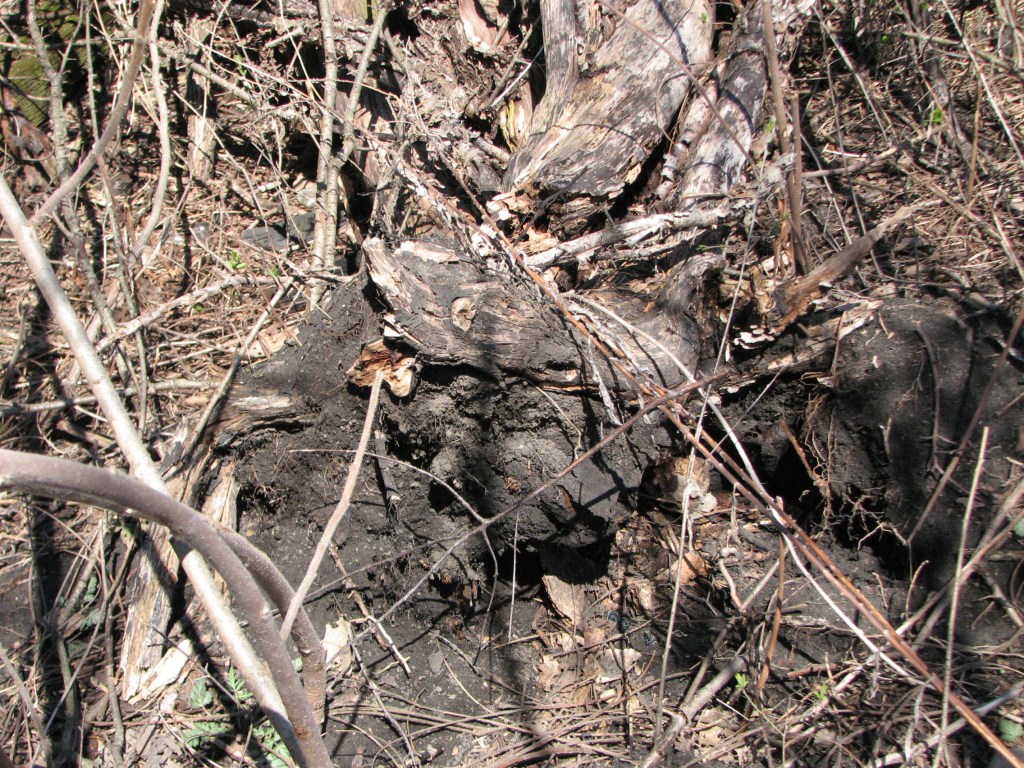
Added 4/20/2026: This is one of the largest common buckthorns that had herbicide applied to it seven years ago. I am including this image to show that this buckthorn has now fallen over and is well on its way to decomposing. If dead common buckthorn are left, they will eventually decompose or burn up in a fire.
Related Posts

 Stewardship Chronicles
Leave a reply to Old Plank Road Prairies May 5th, 2024 – Stewardship Chronicles Cancel reply