Summary
Introduction
Crown Vetch by the Cable Fence
Crown Vetch Under Oak Trees
Discussion
Time to Complete Work, Dispensing Glyphosate Foam, Herbicide Mixes, Maximum Use Rate, Future Work, Patches of Crown Vetch Still Needing to be Treated at Hosah Park, Applying Herbicide Foam to Stems Versus Spraying
Related Posts
Introduction
Below is a link to a Illinois Native Plant Society article about Hosah Park. The site steward is Kathleen Garness.
This blog post provides details of efforts to control crown vetch (Securigera varia) in this high-quality ecosystem.
Crown Vetch by the Cable Fence
The below image was taken immediately after the application on this patch had been completed. Five percent active ingredient glyphosate foam was applied to the stems just above the ground. This herbicide was applied to about four inches of stem length. A total of three ounces of herbicide mixture was used during the treatment of crown vetch by the cable fence. The Green Shoots large foam herbicide dispenser used for these applications is visible in the below image.
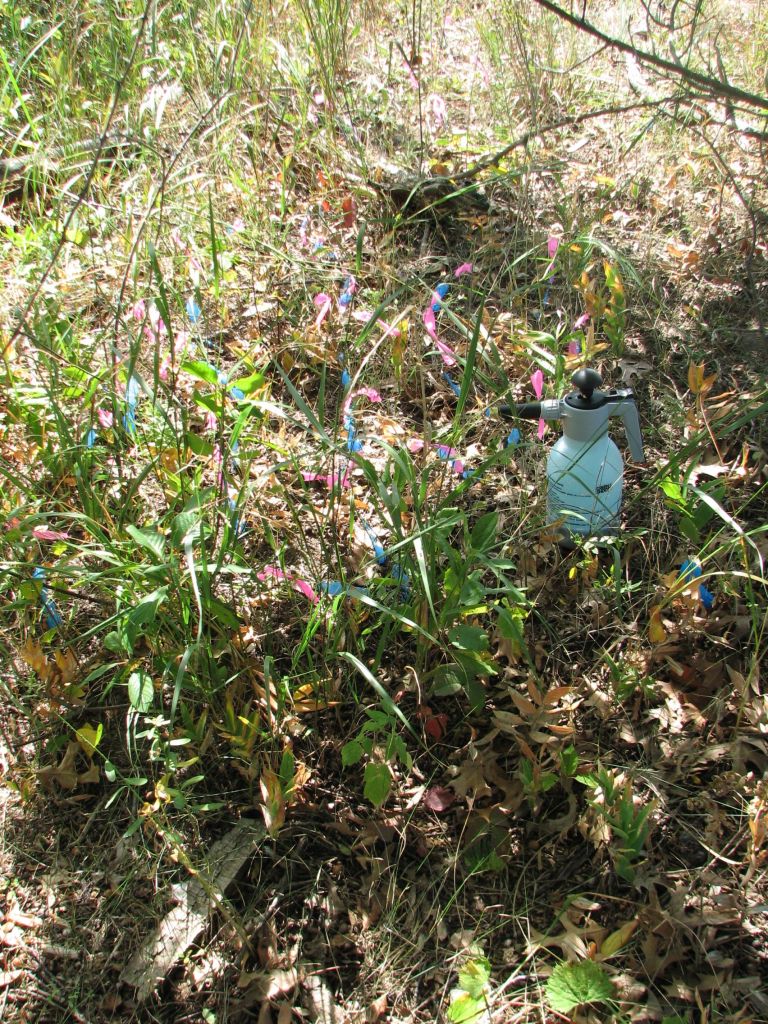
The above patch after the glyphosate foam collapsed onto the stems.

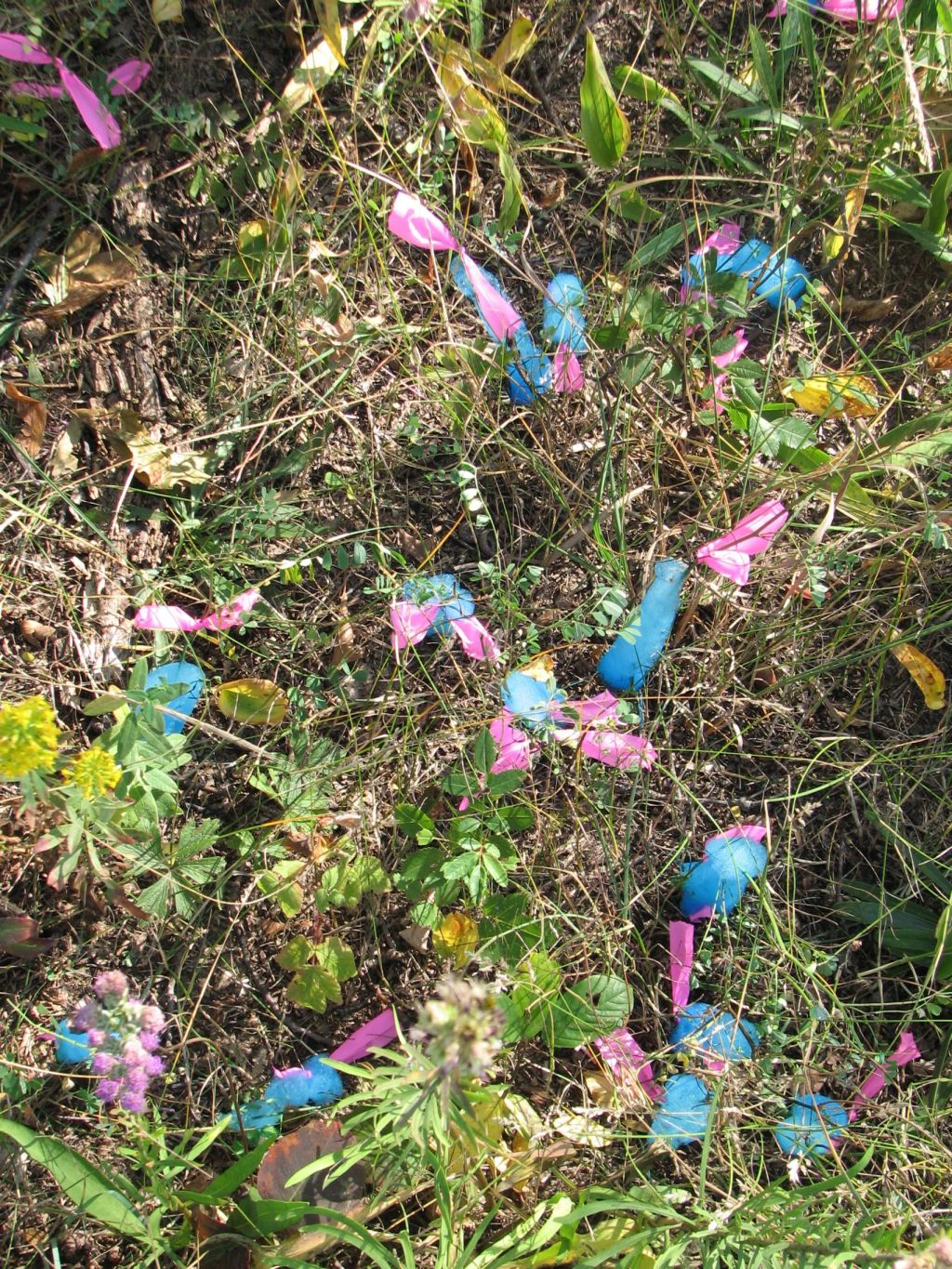
Closer view of the glyphosate foam applied to crown vetch stems immediately after the application on this patch was completed.

View of roughly the same location as above after the glyphosate foam had collapsed onto the crown vetch stems.

Crown Vetch Under Oak Trees
This patch of oak trees is between a sign for Hosah Park that is along the trail before the shelter and the panne. The below image is immediately after half of this crown vetch patch was treated. Four percent glyphosate foam was applied to these crown vetch stems. This herbicide was applied to about four inches of stem length. However, more stem length was covered for larger crown vetch plants. Less than four ounces of this herbicide was applied in this location. This is a surprisingly small amount when compared to the volume used to treat a lessor number of stems by the cable fence. See discussion for details. A lower concentration was trialed in this area because the quality was very high.
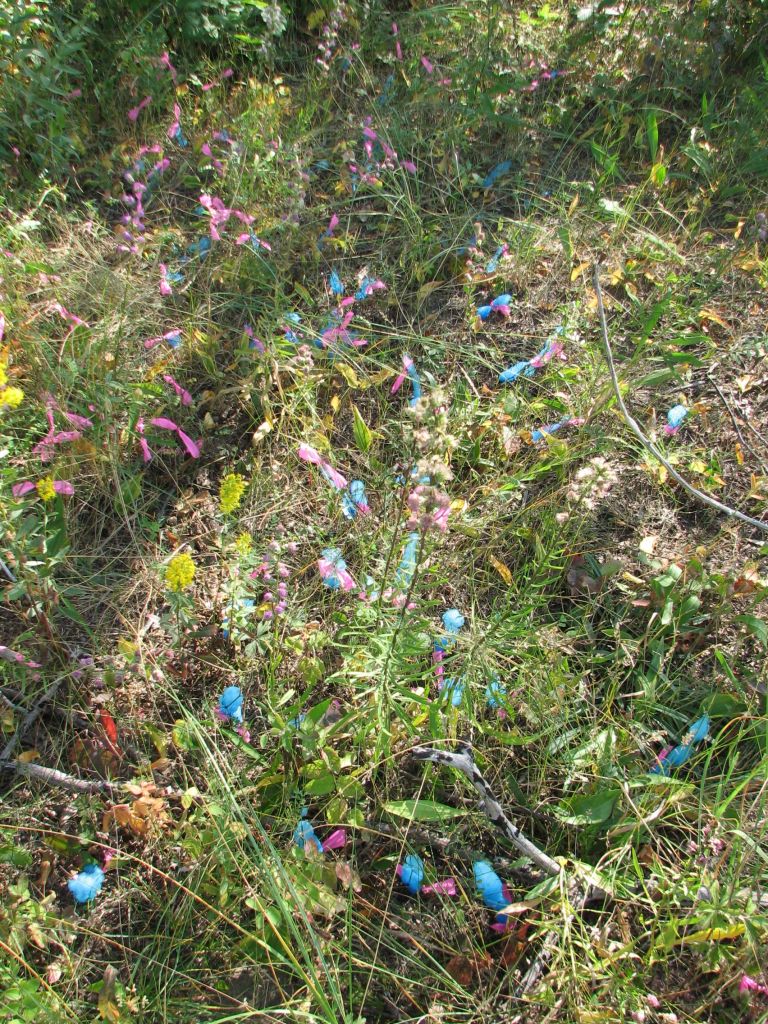
Roughly the same view as above after the glyphosate foam had collapsed.

Closer view of crown vetch stems after herbicide foam was applied that was taken immediately after the application to half of the patch in this location.

Approximately the same view as above after the glyphosate foam had collapsed onto the stems.
Discussion
Time to Complete Work
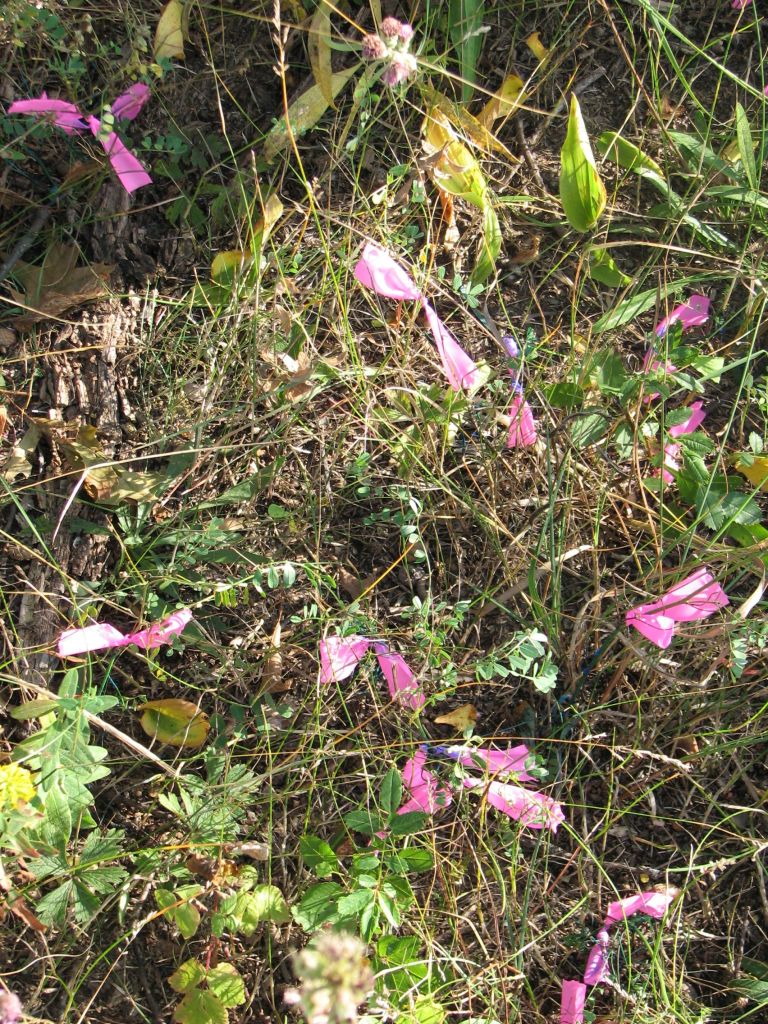
Along the edge and under trees and shrubs just south of the cable fence, surveyor’s tape was tied around 102 crown vetch stems. This took about an hour and a half to complete.
In contrast, applying herbicide to 104 stems in this area only took 30 minutes. This is a stem treated about every 17 seconds. The number of treated stems is higher than stems tied with surveyor’s tape because a few stems were found that had been missed when tying surveyor’s tape on stems.
In the area under oak trees, surveyor’s tape was tied on 165 crown vetch stems. This took an hour and 25 minutes. Surveyor’s tape was tied on stems at a faster rate in this location because of two reasons. First, the stems were in a dense patch eliminating the need to search for them. Secondly, the surveyor’s tape was put in a pocket and pulled out before ripping off a piece to tie on stems. In the area by the cable fence, the surveyor’s tape was taken out of a pocket each time it was needed before ripping off a piece to tie on stems. Taking the surveyor’s tape out of a pocket, ripping off a piece, putting the surveyor’s tape back into a pocket, then repeating took a lot longer than keeping the surveyor’s tape in a pocket and pulling out a length of tape as it was needed.
In the area under the oak trees, glyphosate foam was applied to 176 stems in an hour and thirty-five minutes. Glyphosate foam was applied to several stems that missed being marked with surveyor’s tape. However, the total count was higher than the number actually treated because some stems were double counted toward the end of the day. It was hot and work had continued for several hours. Toward the end of the day, it was difficult to concentrate. I estimate in reality herbicide had been applied to about 170 stems. This is a stem treated about every 34 seconds. After working through the heat of the day and being more expended, the rate of treatment had slowed considerably.
Dispensing Glyphosate Foam
I learn that the Large Foam Herbicide dispenser should not be tipped so the nozzle is pointed straight down. If this is done, then the tip of the tube feeding the nozzle will be above the herbicide level in the tank and into the pressurized air. If the dispenser is triggered when the tip of the tube feeding the nozzle is in pressurized air, then foam will come out of the dispenser faster than expected and be more aerated.
To solve the above problem, the nozzle was kept pointing down at about a 45-degree angle when dispensing herbicide foam onto stems.
It takes finesse. However, if the trigger on the Large Foam Herbicide Dispenser is depressed very gently a slow stream of foam will be created that can be applied to stems of invasive species without getting herbicide on nearby native plants.
Foaming Glyphosate Mixes
Four Percent Active Ingredient
1.9 oz of 41 percent active ingredient glyphosate
0.7 oz of foaming agent
Water added until reaching 20 oz total volume
Five Percent Active Ingredient
3.9 oz of 41 percent active ingredient glyphosate
1.1 oz of foaming agent
Water added until reaching 32 oz total volume
Six Percent Active Ingredient (Not Applied During Visit)
2.9 oz of 41 percent active ingredient glyphosate
0.7 oz of foaming agent
Water added until reaching 20 oz total volume
Maximum Use Rate
The label for 41 percent active ingredient glyphosate gives the maximum use rate of 8 quarts per acre per year. Eight quarts is 256 ounces. An acre is 43,560 square feet. Dividing ounces by square feet yields a value of 0.0058 ounces of this herbicide that can be applied per square foot per year.
Crown Vetch by the Cable Fence
The three ounces of dilute herbicide multiplied by the concentrate added (3.9 ounces) divided by the total amount (32 ounces) yields 0.365 ounce of 41 percent active ingredient glyphosate that was applied to this area.
The amount of concentrate applied (0.365 ounces) divided by the ounces of this herbicide that can be applied per square foot per year (0.0058) yields a minimum area of 62 square feet over which the amount of the dispensed five percent active ingredient glyphosate foam could be applied. Since this crown vetch patch was scattered along the edge of trees and brush I am confident I was well below the maximum use rate of herbicide for this herbicide in a given year.
Crown Vetch Under Oak Trees
Less than four ounces of four percent active ingredient glyphosate foam multiplied by the concentrate added (1.9 ounces) divided by the total amount (20 ounces) yields less than 0.38 ounces of 41 percent active ingredient glyphosate that was applied to this area.
The amount of concentrate applied (less than 0.38 ounces) divided by the ounces of this herbicide than can be applied per square foot per year (0.0058) yields a minimum area of over 66 square feet across which the amount of the dispensed four percent active ingredient glyphosate foam could be applied. I estimate this patch of crown vetch was over 9 ft by 9 ft. My estimates show the amount of four percent active ingredient glyphosate foam applied in this dense patch of crown vetch is nearing the maxium use rate for this herbicide. If I had applied five percent active ingredient glyphosate foam I would likely have come close to reaching the maximum use rate. In dense patches of crown vetch, I will have to be careful not to exceed the maximum use rate when applying glyphosate foam to crown vetch. Depending on my results, this means I might have to do more follow up work in subsequent years when treating dense patches of crown vetch.
Future Work
Next July, I will be able to evaluate the effectiveness of these applications. If the four or five percent active ingredient glyphosate foam concentrations does not prove effective then I am confident six percent active ingredient applied in the manner shown will provide excellent control.
A previous application of four percent active ingredient glyphosate foam that was hand applied to four inches of stem length failed. Applying directly to the stems using the Green Shoots Large Foam Herbicide Dispenser over a given length gets more herbicide on the stem than hand applications. I am hopeful the increased amount applied using this dispenser will be enough to achieve good control. My previous hand applications of six percent active ingredient glyphosate foam had excellent control. The value that will give excellent control and minimize off-target impacts for this method of herbicide application will be somewhere between four and six percent active ingredient glyphosate foam. Next July, I should know if four or five percent active ingredient glyphosate foam works best with this application technique or if the concentration needs to be increased to six percent active ingredient. Although, consideration must be given to the impacts of the on going drought on the effectiveness of the herbicide application. Only about one inch of rain has occurred in over a month with no rain for a few weeks.
Patches of Crown Vetch Still Needing to be Treated at Hosah Park
There is a patch of crown vetch between the unused railroad track and trail to the southwest of this railroad track. This patch was not treated during this visit and needs to be treated in the future.
Applying Herbicide Foam to Stems Versus Spraying
The Related Blog Post, “Illinois Beach 6/8/2024,” shows damaged and killed native vegetation after crown vetch had been sprayed. Applying herbicide foam to each stem takes longer than spraying. It took between 17 to 34 seconds per stem to apply herbicide foam depending on how long the work had been occurring. The tangible benefit from applying herbicide foam to stems should be seen by next year. When crown vetch has been successfully controlled using a targeted technique with the minimum amount of herbicide necessary then the native vegetation grows better the season following application.
Post Script
Rain occurring the Friday morning after the application. This is just over five days since the application was done.

 Stewardship Chronicles
Leave a reply to Selectivity of Glyphosate Foam – Stewardship Chronicles Cancel reply